
Best Smart Thermostat in Canada (2026)
Specs checked November 4, 2026 · Version française
Most smart thermostat round-ups put a Nest or an ecobee at the top. For a large share of Canadian homes, Quebec above all, both are the wrong purchase: they cannot switch an electric baseboard heater at all. The first question is not which brand, it is what heats the room. Answer that, and the list of possible thermostats shrinks from dozens to three or four.
The short answer
- Baseboards, only two wires in the box: Sinopé TH1123WF. Its listing accepts 2 or 4 wire connections.
- Baseboards, four wires, many rooms: Mysa LITE in most rooms, a Mysa V2 where you want the screen and humidity reading.
- Electric heated floor: a floor thermostat with a sensor, such as the Sinopé TH1310WF. Not a baseboard model.
- Furnace or central heat pump (24 V): ecobee Essential as the default, Nest Learning 4th gen if you want it to build the schedule itself.
How we picked, and what we did not do: we have not bench-tested these thermostats. Every specification on this page is quoted from the product’s own Amazon.ca listing, checked November 4, 2026, and every unit below was confirmed in stock in Canada that day. Where a listing contradicts itself, we say so. Links to Amazon are affiliate links; BranchéQC may earn a commission at no extra cost to you. We do not publish prices by hand, so the button says “Check price” and the Amazon page is what counts.
First question: what heats your home?
Two completely different kinds of thermostat are sold under the same “smart thermostat” label, and they are not interchangeable.
| Your heating | Thermostat type | Picks on this page |
|---|---|---|
| Electric baseboards, convectors, fan-forced wall heaters | Line voltage, 120 or 240 V | Sinopé TH1123WF, Mysa LITE, Mysa V2 |
| Electric heated floor (cables or mats) | Line voltage with a floor sensor | Sinopé TH1310WF |
| Furnace, forced air, central heat pump, boiler | Low voltage, 24 V | ecobee Essential, Nest Learning, Honeywell T9 |
| Wall-mounted ductless heat pump | Neither: its own remote | None. See the mini-split section |
A line-voltage thermostat sits directly in the heater’s power circuit and switches the full current that warms the element. A low-voltage thermostat never touches that current: it sends a 24 V signal that tells a furnace or heat pump control board to start. A 24 V thermostat has no way to switch a baseboard circuit, and connecting one to 240 V can destroy it. The Honeywell T9 listing states the rule outright: it does not work with electric baseboard heat (120 to 240 V).
Line-voltage smart thermostats for baseboards and convectors
This is the case American reviews skip. Three things decide whether a given model works on your wall.
1. The load on the circuit. Every line-voltage thermostat has a maximum wattage. Add up the wattage printed on the label of every heater that this one thermostat controls; often that is more than one baseboard. The Sinopé TH1123WF is rated 3,000 W at 240 V, which works out to 12.5 A (3,000 divided by 240). Both Mysa baseboard models are rated 3,800 W at 240 V, about 15.8 A, and 1,900 W at 120 V. Two 1,500 W baseboards on one thermostat add up to 3,000 W: exactly at the Sinopé’s ceiling, comfortably inside Mysa’s. A 2,000 W heater plus a 1,500 W one makes 3,500 W: too much for the Sinopé, still within Mysa. Above 3,800 W, neither fits, and splitting that load is an electrician’s job, not a thermostat purchase.
2. The number of wires. A smart thermostat needs power for its Wi-Fi radio. Both Mysa listings say it needs at least four wires, including a neutral or a second live wire, and will not work on a two-wire installation. The Sinopé TH1123WF listing says it is compatible with 2 or 4 wire connections. If you open the box and find only two wires, that single line in the listing decides the purchase.
3. The voltage. Most Canadian baseboards run on 240 V, but some smaller heaters run on 120 V. The Mysa listings cover both. The Sinopé TH1123WF listing gives 240 V only, so on a 120 V heater, go with Mysa.
One more detail: the Mysa LITE listing describes it as a single-pole thermostat that replaces many single-pole and double-pole thermostats, and adds that local codes vary. A double-pole thermostat usually has a true off position that cuts both legs of the circuit. If yours does and you rely on that, ask the electrician whether a single-pole replacement is acceptable where you live.
For a heated floor, none of the baseboard models apply: the Sinopé TH1123WF listing excludes heating floors in writing. A floor thermostat regulates on a sensor buried in the floor, and the Sinopé TH1310WF ships with a 15 ft sensor and a 3,600 W rating.
Low-voltage (24 V) thermostats for furnaces and central heat pumps
If your home has ducts and a single thermostat in the hallway, you are in the territory every American review covers, and the question becomes the C-wire. That common wire supplies continuous 24 V power to the thermostat. Older systems often lack one. The three listings handle it three ways: ecobee’s Essential needs a Power Extender Kit, sold separately, when there is no C-wire; Google says the 4th gen Nest Learning needs no C-wire in most homes; Honeywell’s T9 says “C-Wire Required” in its title, then says the power adapter in the box makes it work in most homes.
Central heat pumps add a second check: ecobee lists heat pumps as 2H/1C and Honeywell names heat pumps with electric backup. A cold-climate heat pump with auxiliary heat strips is exactly the system to run through each brand’s online compatibility checker before you open the box.
What about a wall-mounted heat pump?
None of the seven thermostats on this page control a ductless mini-split: a wall unit takes its orders from its own infrared remote. To schedule it from a phone, the options are the manufacturer’s Wi-Fi adapter, where one exists, or a separate infrared smart controller that mimics the remote. The manufacturer’s adapter reads the unit’s real status; an infrared controller cannot tell whether the unit received the command. Ask your installer which one your model supports, ideally before the quote is signed.
The seven thermostats, compared on published specs
Every figure is the manufacturer’s own. Low-voltage models do not switch the heating load, so they have no wattage rating.
| Model | Voltage | Rated load | Wiring / power |
|---|---|---|---|
| Sinopé TH1123WF | 240 V line voltage | 3,000 W max | 2 or 4 wire |
| Mysa LITE | 120 V or 240 V line voltage | 1,900 W at 120 V · 3,800 W at 240 V | 4 wires, neutral or second live |
| Mysa V2 | 120 V to 240 V line voltage | 1,900 W at 120 V · 3,800 W at 240 V | 4 wires, neutral or second live |
| Sinopé TH1310WF (heated floor) | 240 V line voltage | 3,600 W | 15 ft floor sensor included |
| ecobee Smart Thermostat Essential | 24 VAC | n/a (low voltage) | C-wire, or Power Extender Kit sold separately |
| Google Nest Learning Thermostat (4th gen) | Most 24 V systems | n/a (low voltage) | No C-wire needed in most homes (per Google) |
| Honeywell Home T9 | 24 V | n/a (low voltage) | C-wire required (adapter in box) |
Which one for your home
Baseboards, convectors and heated floors (line voltage)
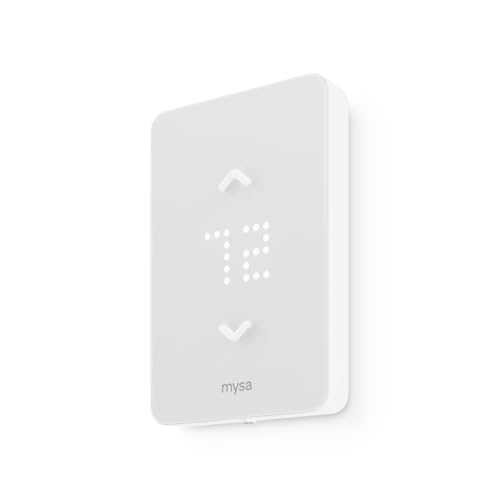
Sinopé TH1123WF240 V line voltage · 3,000 W maxThe default for a baseboard or convector room, and the one to try first if your box has only two wires. Neviweb app with up to 8 schedule periods a day, geofencing and energy reports; no hub; Apple Home, Alexa and Google Home.Watch out: The listing gives 240 V only, with a 3,000 W ceiling. It also states it is not compatible with heated floors or HVAC systems.Check price ↗Mysa LITE120 V or 240 V line voltage · 1,900 W at 120 V · 3,800 W at 240 VThe lower-cost way to put every baseboard room on a phone schedule: 7-day scheduling, geofencing, vacation mode, a monthly runtime email. Designed in Newfoundland, 5-year limited warranty on units sold by Mysa, support in English and French.Watch out: It will not work on a two-wire switch loop. No in-app energy charts and no humidity sensor: the listing itself points you to the V2 for those.Check price ↗Mysa V2120 V to 240 V line voltage · 1,900 W at 120 V · 3,800 W at 240 VThe room you look at most: touchscreen, humidity sensor, a body Mysa says is 40 % smaller than before, and a display that dims for sleep and wakes on approach.Watch out: Same wiring rule as the LITE: at least four wires, no two-wire installations. The screen is wasted in a spare bedroom.Check price ↗Sinopé TH1310WF (heated floor)240 V line voltage · 3,600 WElectric in-floor heating with cables or mats, typically a bathroom or a basement slab. A second output can drive an auxiliary heater, or up to 10 TR1310 expansion units when the floor exceeds 15 A.Watch out: A floor thermostat, not a baseboard one. If your floor sensor is missing or dead, it regulates nothing useful.Check price ↗


Furnaces, boilers and central heat pumps (24 V)
ecobee Smart Thermostat Essential24 VAC · C-wire, or Power Extender Kit sold separatelyThe sensible default for a furnace, a boiler or a central heat pump: colour touchscreen, indoor humidity detection, time-of-use preheating, HomeKit, Google Assistant and Alexa. Room SmartSensors can be added later.Watch out: ecobee itself says it fits 85 % of systems, and lists heat pumps as 2H/1C. With no C-wire, the Power Extender Kit is an extra purchase.Check price ↗Google Nest Learning Thermostat (4th gen)Most 24 V systems · No C-wire needed in most homes (per Google)A central system where you want the thermostat to build its own schedule. One Nest Temperature Sensor (2nd gen) comes in the box for the room that is always too cold.Watch out: The premium of the three low-voltage picks. The 12 % average heating saving in the listing is Google's own claim, not ours.Check price ↗Honeywell Home T924 V · C-wire required (adapter in box)Forced air, hot water and steam systems, and heat pumps with electric backup. Energy Star certified, geofencing, room sensors sold separately, Wi-Fi on 2.4 and 5 GHz.Watch out: The listing says both "C-Wire Required" and that a power adapter in the box makes it work in most homes. Read that as: no C-wire, plan on installing the adapter.Check price ↗


Installing a line-voltage thermostat
Replacing a baseboard thermostat looks like a quick swap, but the wires behind it carry 240 V and the full current of the heaters. Turn the breaker off at the panel, confirm the circuit is dead with a tester, and match the wiring to the instructions rather than to what you think was there. Mysa’s own listing tells buyers to hire an electrician where code requires it, or if they are not comfortable with high-voltage wiring.
In Quebec, electrical work is regulated, and a licensed master electrician is the safe route for 240 V thermostats, especially when you are doing a whole house at once or when the load adds up close to the thermostat’s rating. If you are in Quebec, you can request a free quote from a licensed master electrician through BranchéQC. Elsewhere in Canada, follow your province’s rules on who may do the work.
Smart thermostat rebates and Hydro-Québec’s Hilo
In Quebec, smart thermostats connect to Hilo, Hydro-Québec’s connected-home service. Hilo uses Sinopé thermostats to run “challenges” during winter peaks: the thermostat lowers the heat slightly for you during peak hours, and you receive credits in return. Hydro-Québec has also offered thermostats at reduced or no cost during some promotions, and smart thermostats are among the efficiency measures recognized under LogisVert. Amounts and conditions change from season to season, so check the offer in force and the models Hilo supports before buying.
Outside Quebec, we do not publish rebate figures we cannot verify. Check your province and your electricity or gas utility: Honeywell’s T9 listing, for one, mentions connecting with your utility’s efficiency program.
What the American reviews leave out
- Baseboard heat is the norm in a large share of Canadian homes. American round-ups are written for ducted houses with one thermostat. Here, a baseboard home has one thermostat per room, so the budget is the price of one unit multiplied by the number of zones, and the cheaper model often wins on that math alone.
- Winter peaks, not summer cooling. In Quebec, the moment that counts is the winter peak, which is why Hydro-Québec’s Hilo challenges happen then. A thermostat that a utility program can talk to matters more here than in a market built around air conditioning.
- Two-wire boxes in older houses. Many older baseboard installations have only two wires at the thermostat. A model that needs four, however good its app, simply will not install. Check before you buy six of them.
Where to buy in Canada
| Retailer | Strength | Note |
|---|---|---|
| Amazon.ca | Widest choice of Sinopé, Mysa, ecobee and Nest | Check 240 V or 24 V in the listing before adding to cart |
| Home Depot / RONA | Local stock, both baseboard and central models | Staff are not always familiar with line-voltage wiring |
| Best Buy | Nest and ecobee central models | Little choice on the baseboard side |
| Hydro-Québec / Hilo (Quebec) | Sinopé kits and offers, depending on promotions | Check the offer in force before buying elsewhere |
Frequently asked questions
Does a Nest or an ecobee work with electric baseboard heaters?
No. Both are low-voltage thermostats built for 24 V equipment, while a baseboard heater is switched directly at 120 or 240 V. For baseboards you need a line-voltage smart thermostat such as Sinopé or Mysa.
Mysa or Sinopé: which is better for baseboards?
Start with the wires in your wall box: Mysa needs four and will not work on a two-wire switch loop, while the Sinopé TH1123WF listing accepts 2 or 4. With four wires, compare the load: Mysa is rated 3,800 W at 240 V, the Sinopé 3,000 W. On a 120 V heater, only Mysa lists support.
How many smart thermostats do I need for baseboard heat?
One for every thermostat already on your walls. Most people start with the rooms they use most, such as the living room and bedrooms, and add the rest later.
What is a C-wire and do I need one?
The common wire supplies constant 24 V power to a low-voltage thermostat, so it only matters for furnaces, boilers and central heat pumps. Baseboard thermostats do not use one at all.
Are there smart thermostat rebates in Canada?
In Quebec, Hydro-Québec's Hilo service uses Sinopé thermostats for winter peak challenges that earn credits, Hydro-Québec has offered thermostats at reduced or no cost during some promotions, and smart thermostats are among the efficiency measures recognized under LogisVert. Amounts and conditions change from season to season, so check the current offer. Elsewhere in Canada, check your province and your utility before you buy.
Can I install a line-voltage smart thermostat myself?
The swap is simple, but the circuit carries 240 V, and Mysa's own listing says to hire an electrician where code requires it. In Quebec, electrical work is regulated; a licensed master electrician is the safe route.
How much does a smart thermostat save on heating?
Mysa's listing says up to 26 % on heating, Google's an average of 12 % on heating bills for the Nest. We have not measured either. The saving comes from turning the heat down at night and when the house is empty, so it depends on whether you actually set a schedule.
Keep reading
One cold room that the baseboard never quite heats? Our guide to the best space heaters in Canada explains why every plug-in model stops at 1,500 W and what that actually heats. Thinking about replacing baseboards altogether? Our heat pump installation guide for Quebec covers air-source, geothermal and ductless systems, with all-in pricing and rebates. And for the living room, the best electric fireplaces in Canada compares inserts, wall-mounted and mantel models on their published specs.