

Top choices
Specs as stated on the manufacturers' listings; the price shows on the retailer's page. Family · two pairs, or boots and glovesDryGuy DX Forced Air Boot and Garment DryerTwo pairs of boots, or one pair plus gloves, dry before the next outing. Two extension tubes for boots up to 16 inches (about 41 cm) tall, and the listing says its 40.5 °C (105 °F) air is safe for liners.Watch out: Only two extension tubes are included, so two tall boots at a time. No wattage on the listing, and a 1-year warranty.Check price on Amazon.ca ↗
 Skates, ski boots · digital timerPEET Apex 2-Pair Forced Air DryerSkates, ski boots and cleats in a small space: the base is a 10-inch (about 25 cm) cube. The listing names hockey skates, says the air is pushed into the toe box, lists leather as safe and cites ETL safety standards.Watch out: Glove and Helmet DryPorts are sold separately. No wattage and no air temperature on the listing; the 2-year warranty requires registration within 10 days.Check price on Amazon.ca ↗
 Work boots · wattage statedJobSite Mighty Dry Boot DryerWork boots that have to be dry for the next shift. The most complete listing among the fan models: drying time by wetness, temperature range, heater wattage and a 2-year warranty.Watch out: The timer stops at 3 hours, the top of the listing's own range for wet boots: a soaked pair may need a second cycle. No fan-only setting is mentioned.Check price on Amazon.ca ↗
Wet boots at the door are the daily tax of a Canadian winter: slush from the walk to school, sweat in a ski liner, a work boot that never quite dries between two shifts. A boot dryer is a small heater, with or without a fan, that sends warm air up into the boot. Which one suits your entryway comes down to three things: the type (silent convection or forced air), the number of pairs that come home wet on the same evening, and the heat your boots can take.
The short answer
- One pair, dry by morning, no noise: a convection dryer. The PEET Original has no fan and is meant to stay plugged in.
- Two pairs, or boots plus gloves, tonight: a four-port forced air dryer like the DryGuy DX, which states 1 to 2 hours and a 3-hour timer.
- Skates and ski boots in a small space: the PEET Apex, a 10-inch cube with a digital timer.
- Leather or heat-moulded liners: low heat or no heat, and the boot maker’s care instructions before anything a dryer listing says.
How we picked, and what we did not do: we have not dried a single boot on these machines. Every specification on this page is quoted from the manufacturer’s Amazon.ca listing, checked November 10, 2026, and every product on a card was in stock in Canada that day. Where a listing leaves a number out, we write “not stated” rather than guess. Links to Amazon are affiliate links; BranchéQC may earn a commission at no extra cost to you. We do not write prices by hand: the button says “Check price on Amazon.ca” and the Amazon page is what counts.
Convection or forced air: the two kinds of boot dryer
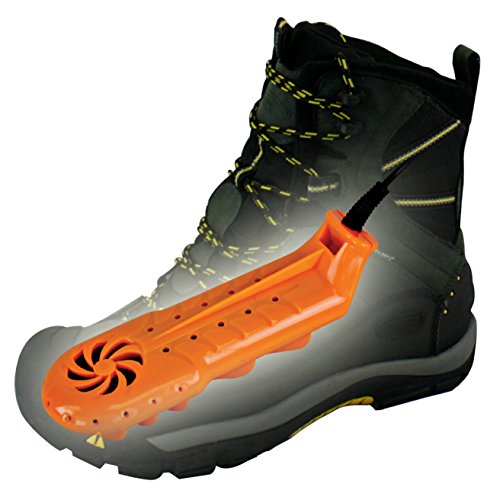
Convection is silent and slow. A low-power element warms the air at the base, the warm air rises through the tube and out of the boot, and nothing moves. The JobSite Original puts numbers on it: 36 watts, 8 hours for damp boots, 12 hours for wet ones. The PEET Original says “most footwear overnight”. This is the type for a bedroom closet or a hallway next to a nursery.
Forced air is faster and audible. A fan pushes warmed air down to the toe box. Stated times drop to 1 to 2 hours on the DryGuy DX, 1 to 4 hours on the PEET Apex, and 30 minutes to 3 hours on the JobSite Mighty Dry depending on how wet the boot is. Fan dryers come with a timer, and some add a no-heat setting that moves room-temperature air only.
A hybrid exists for travel. The DryGuy Travel Dry DX describes itself as convection combined with forced air in a portable format. Its listing gives no drying time, so treat it as a travel tool, not as a replacement for a floor unit.
Makers call their fans “whisper quiet”. None of the seven listings gives a decibel figure, so we cannot rank them on noise. The only models that are silent by construction are the two with no fan.
How many pairs do you need to dry at once?
Count the wet pairs on your worst evening, not your average one. One adult who walks to work needs one pair dry by morning: any convection unit does it. Two kids back from the sledding hill at 4 p.m. with a hockey practice at 6 is a different problem, and only a fan dryer with two pairs of ports solves it.
- One pair: PEET Original (stated as a 2-shoe dryer). The FORLIM has dual ports.
- Two pairs: PEET Apex and JobSite Mighty Dry, both stated as two pairs at once. The DryGuy DX states four items at once.
- More than two pairs: no pick here claims it. Run two cycles on a fan model, or put a second silent unit where the other boots live.
Tall boots change the count. The DryGuy DX ships with two extension tubes for boots up to 16 inches (about 41 cm), so it handles two tall boots and two low items at the same time, not four tall boots.
The seven boot dryers, compared on published specs
Every figure is the manufacturer’s own. Where a listing gives no number, the table says so rather than guessing.
| Model | Type | Capacity | Stated drying time | Timer and heat | Wattage |
|---|---|---|---|---|---|
| PEET Original 2-Shoe Dryer | Convection, no fan | 1 pair (2 shoes) | Most footwear overnight | No timer mentioned; left plugged in 24/7 | Not stated (“less than a low wattage household light bulb”) |
| DryGuy DX Forced Air Boot and Garment Dryer | Forced air, rotary blower | 4 items at once | Most clothes in 1 to 2 h | 3 h timer; heat or no-heat switch; 40.5 °C (105 °F) | Not stated |
| PEET Apex 2-Pair Forced Air Dryer | Forced air, fan | 2 pairs | 1 to 4 h | Digital timer to 240 min in 30-min steps, then auto-off | Not stated |
| JobSite Mighty Dry Boot Dryer | Forced air, fan | 2 pairs | Damp 30 to 60 min; wet 1 to 3 h | 3 h timer; 98 to 110 °F (about 37 to 43 °C) | 200 W heater |
| JobSite Original Silent Boot Dryer | Convection, no fan | Not stated in the listing | Damp 8 h; wet 12 h | No timer mentioned | 36 W |
| DryGuy Travel Dry DX | Hybrid: convection plus forced air | Not stated in the listing | Not stated | No timer mentioned; heats to “99 degrees” | Not stated; AC/DC adaptor |
| FORLIM Forced Air Shoe and Boot Dryer | Forced air, fan | Dual ports | Damp footwear in about 1 to 2 h | Dial timer 0 to 120 min; 104 to 140 °F (40 to 60 °C) | 200 W |
Which boot dryer for your winter
PEET Original 2-Shoe DryerConvection, no fan · 1 pair (2 shoes)The quiet default for a hallway or a bedroom closet: gently warmed air rises through the boot, with no fan. Listed as safe on leather, rubber, neoprene, canvas and synthetics, with a 25-year warranty if you register within 10 days.Watch out: One pair at a time, and overnight, not in an hour. The listing describes it as always on and mentions no timer.Check price on Amazon.ca ↗DryGuy DX Forced Air Boot and Garment DryerForced air, rotary blower · 4 items at onceTwo pairs of boots, or one pair plus gloves, dry before the next outing. Two extension tubes for boots up to 16 inches (about 41 cm) tall, and the listing says its 40.5 °C (105 °F) air is safe for liners.Watch out: Only two extension tubes are included, so two tall boots at a time. No wattage on the listing, and a 1-year warranty.Check price on Amazon.ca ↗PEET Apex 2-Pair Forced Air DryerForced air, fan · 2 pairsSkates, ski boots and cleats in a small space: the base is a 10-inch (about 25 cm) cube. The listing names hockey skates, says the air is pushed into the toe box, lists leather as safe and cites ETL safety standards.Watch out: Glove and Helmet DryPorts are sold separately. No wattage and no air temperature on the listing; the 2-year warranty requires registration within 10 days.Check price on Amazon.ca ↗JobSite Mighty Dry Boot DryerForced air, fan · 2 pairsWork boots that have to be dry for the next shift. The most complete listing among the fan models: drying time by wetness, temperature range, heater wattage and a 2-year warranty.Watch out: The timer stops at 3 hours, the top of the listing's own range for wet boots: a soaked pair may need a second cycle. No fan-only setting is mentioned.Check price on Amazon.ca ↗JobSite Original Silent Boot DryerConvection, no fan · Not stated in the listingSilent overnight drying with numbers on the listing: 36 watts, 8 hours for damp boots, 12 for wet ones. No fan, no motor, no moving parts, and a 2-year warranty.Watch out: Twelve hours for wet boots means evening to morning, nothing faster. The listing does not say how many boots it holds.Check price on Amazon.ca ↗DryGuy Travel Dry DXHybrid: convection plus forced air · Not stated in the listingSki trips, hotel rooms and the drive home: an AC/DC power adaptor runs it at home or in the car, and the listing says it packs in carry-on luggage.Watch out: No drying time, no wattage and no timer on the listing, and “99 degrees” comes without a unit.Check price on Amazon.ca ↗FORLIM Forced Air Shoe and Boot DryerForced air, fan · Dual portsThe least expensive of our picks when we checked. Telescopic, bendable ports that reach the toe box, a rack that rotates from flat to upright, ETL certified and a 2-year warranty, all as listed.Watch out: Upright, it fits boots up to a 21 cm (about 8 in) shaft. Its 60 °C (140 °F) top end is the hottest here: follow the boot's care label, as the listing itself says.Check price on Amazon.ca ↗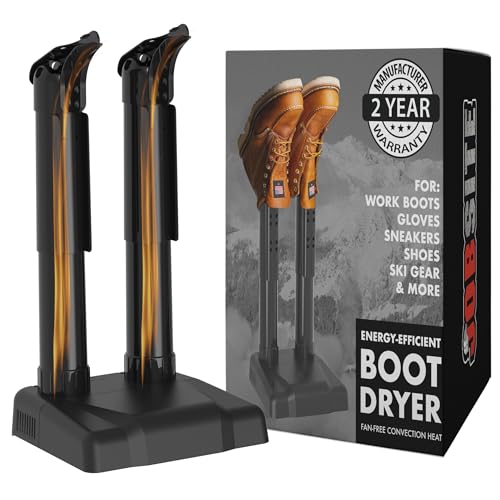

PEET boot dryer or DryGuy boot dryer?
These are the two names most shoppers type. PEET covers both types. The Original is the silent convection unit. The Apex is the compact two-pair fan unit. Between them, the PEET Advantage Plus lists two pairs at once, heat or no-heat, 1 to 4 hours and a push-button LED display; note that its materials list names rubber, vinyl, neoprene, canvas and synthetics but not leather, unlike the Original and the Apex. The PEET Multi 4 with a Glove DryPort showed only scarce stock on November 10, 2026, so it is not a pick.
DryGuy is forced air first. The DX is the four-port floor unit with a 3-hour timer and a heat or no-heat switch; the Travel Dry DX is the portable one with an AC/DC adaptor. A newer DryGuy Force with a digital screen showed a delivery lead time rather than stock that day, so we left it out.
On warranty, as the listings state it: 25 years on the PEET Original and 2 years on the Apex, both conditional on registering within 10 days of purchase; 1 year on the DryGuy DX. Neither brand states a wattage on the listings we read.
Ski boot dryer: liners, shells and heat-moulded fits
A ski boot is the hard case: a plastic shell that lets nothing out and a thick liner that holds a day of sweat. A liner that goes back on damp is cold by the second run, which is also why heated socks work better in a boot that started the day dry.
What the listings say: the DryGuy DX heats to 40.5 °C (105 °F) and calls that safe for liners; both JobSite units name ski and snowboard boot liners; the PEET Apex names ski and snowboard boots. A separate Amazon.ca listing for the Travel Dry DX (model 02170) states it will not damage or shrink heat moulded liners and footbeds; the listing behind our card does not repeat that sentence.
A heat-moulded liner was shaped with heat in the shop, so the question is fair: can a dryer reshape it? No dryer listing gives a temperature limit for your liner. That number belongs to the boot maker. Read the care instructions that came with the boots, and when in doubt run the dryer on no-heat, which the DryGuy DX and the PEET Advantage Plus both offer.
Hockey skates and work boots
Skates. The PEET Apex listing names hockey skates, next to cleats and sneakers. A dryer deals with the boot, not the steel: wipe the blades by hand before the skates go on the ports. For a skate with a heat-moulded boot, the same rule as ski liners applies: the skate maker’s instructions first.
Work boots. The water sits in the toe box, and a tall leather upper keeps it there. Look for a listing that says the air reaches the toe: the PEET Apex says so, and the FORLIM has telescopic ports for that purpose. The JobSite Mighty Dry is the one fan model that states its heater wattage and its times by wetness, which makes planning around a shift simple: damp boots in an hour, wet boots in up to three.
If you clear the driveway before leaving, the boots get wet twice a day. Our guide to the best electric snow shovels in Canada covers the tool that shortens that job.
Glove dryer: mitts and gloves on the same unit
You rarely need a separate glove dryer. A four-port forced air unit takes a pair of boots and a pair of gloves in the same cycle, and the DryGuy DX is sold as a boot, glove and garment dryer. Both JobSite units and the FORLIM list gloves too. The MaxxDry Heavy Duty boot and glove dryer is built on the same idea: 40.5 °C (105 °F), most items in about an hour, removable 16-inch extension tubes, a heat or no-heat switch and a 3-hour timer, as listed. Its listing does not say how many items it holds.
PEET does it with attachments. The Apex listing points to Glove and Helmet DryPorts, sold separately, for gloves, boxing gloves and helmets on the same base.
Battery-heated gloves are a special case. Take the batteries out first and check the glove maker’s instructions before putting a wired glove on a warm port. Our guide to the best heated gloves in Canada covers their washing and drying rules.
Shoe dryer for runners and travel
Six of the seven picks list shoes or sneakers by name (the DryGuy DX listing speaks of boots, gloves and garments), so a boot dryer is also a shoe dryer. What changes is the fit. A running shoe on a tall extension tube sits crooked; short ports or a flat rack hold it better. The FORLIM rack rotates from flat to upright, and its listing names sneakers and slippers. The PEET Apex sets a timer in 30-minute steps, and suggests half an hour for damp gym sneakers.
For a portable shoe dryer, the DryGuy Travel Dry DX is the one in our picks that runs from a car outlet as well as a wall outlet. Its listing gives no time and no wattage, so do not plan a tight turnaround around it.
Heat, leather and care labels
| Model | Air temperature (as listed) | Leather named as safe |
|---|---|---|
| PEET Original | Not stated | Yes |
| DryGuy DX | 40.5 °C (105 °F); no-heat switch | Not named; “liners, clothes, and boots” |
| PEET Apex | Not stated | Yes |
| JobSite Mighty Dry | 98 to 110 °F (about 37 to 43 °C) | Leather boots listed among uses |
| JobSite Original | Not stated | Leather boots listed among uses |
| DryGuy Travel Dry DX | “99 degrees”, unit not given | Not named |
| FORLIM | 104 to 140 °F (40 to 60 °C) | Yes, “follow care labels” |
The dryers that state a temperature mostly sit around 40 °C (105 °F), close to the temperature of a warm bath. The FORLIM range goes higher, and its own listing tells you to follow care labels. For good leather boots, a waxed or oiled finish, glued soles or a waterproof membrane, the boot maker’s care instructions outrank any dryer listing. If they say to dry away from heat, use a no-heat setting or a silent convection unit and give it the night.
Where to put it: outlet, drip tray, air
- Near a wall outlet in the mudroom or entry. The DryGuy DX and the MaxxDry list a 6-foot (about 1.8 m) cord. Check the manual before adding an extension cord.
- On a boot tray. Knock the snow off outside first. The dryer handles the inside of the boot; the meltwater running off the outside needs a drip tray under it, and the dryer itself should stay out of the puddle.
- With air around it. A fan model needs a clear intake. One portable dryer listing we read warns against covering the air inlet or outlet and against putting dripping-wet items on the unit; your manual has the rule for yours.
- Where the noise does not matter. A fan unit belongs in the mudroom, the garage entry or the basement. Next to a bedroom, take a model with no fan.
- Measure the footprint. The DryGuy DX is 15 in wide by 12 in deep (about 38 by 30 cm); the PEET Apex is a 10-inch (about 25 cm) cube.
Running cost: watts times hours
A boot dryer is a small load. Energy is watts × hours ÷ 1,000 = kilowatt-hours. Only three of our listings state a wattage, so only three can be worked out:
| Model | Wattage (as listed) | Example run | Energy |
|---|---|---|---|
| JobSite Original | 36 W | 12 h, wet boots as listed | 0.43 kWh |
| JobSite Mighty Dry | 200 W heater | 3 h, full timer | 0.6 kWh |
| FORLIM | 200 W | 2 h, full timer | 0.4 kWh |
Multiply the last column by the rate on your own bill. A silent unit left plugged in around the clock is where it adds up: 36 W for 24 hours is 0.86 kWh a day. The PEET Original is described as always on and as using “less electricity than a low wattage household light bulb”, but its listing gives no wattage, so we cannot put a number on it. The JobSite Mighty Dry figure covers the heater only; the fan’s draw is not stated.
Where to buy a boot dryer in Canada
| Retailer | Strength | Note |
|---|---|---|
| Amazon.ca | Widest range: PEET, DryGuy, JobSite, MaxxDry, travel models, accessories | Check the brand line and whether attachments are included |
| Hardware and workwear stores | May carry boot dryers in season | Range varies by store and by winter |
| Ski and hockey shops | May carry dryers aimed at liners and skates | Ask what heat setting they use on moulded liners |
Frequently asked questions
What is the best boot dryer in Canada?
For one pair dried in silence overnight, the PEET Original. For two pairs or boots plus gloves in 1 to 2 hours, the DryGuy DX forced air dryer. For skates and ski boots in a small space, the PEET Apex. All three were in stock on Amazon.ca on November 10, 2026.
Is a PEET boot dryer worth it?
The PEET Original listing promises silent convection drying overnight, materials including leather, and a 25-year warranty if you register within 10 days. It dries one pair at a time and states no wattage. If you need two pairs in an evening, look at a forced air model instead.
Is a DryGuy boot dryer safe for ski boot liners?
The DryGuy DX listing says it heats to 40.5 °C (105 °F) and is safe for liners, clothes and boots, and it has a no-heat switch. For a heat-moulded liner, confirm with your boot maker's care instructions and use no-heat when in doubt.
How long does a boot dryer take?
As listed: 8 hours for damp boots and 12 for wet ones on a silent convection unit, against 30 minutes to 3 hours on a 200 W fan unit and 1 to 4 hours on the PEET Apex. Real times depend on the material and how soaked the boot is.
Can a boot dryer be used as a shoe dryer?
Yes. Six of the seven picks here list shoes or sneakers by name. Low shoes sit best on short ports or a flat rack; tall extension tubes are for boots.
Can you dry gloves on a boot dryer?
On most fan models, yes: the DryGuy DX, both JobSite units and the FORLIM list gloves. The PEET Apex needs Glove DryPorts sold separately.
Does a boot dryer use a lot of electricity?
Little. A 36 W convection unit running 12 hours uses about 0.43 kWh; a 200 W heater on a full 3-hour timer uses 0.6 kWh. Multiply by the rate on your own bill.
Can a boot dryer damage leather boots?
Several listings name leather as safe, at air temperatures around 40 °C (105 °F). One budget unit goes up to 60 °C (140 °F) and tells you to follow care labels. Your boot maker's care instructions have the final word.
Where can I buy a boot dryer in Canada?
Amazon.ca had every model on this page in stock on November 10, 2026. Hardware, workwear and ski shops may carry boot dryers in season; check stock online before you drive.
Keep reading
Dry boots are half of warm feet. For the other half, see the best heated socks in Canada and, for the hands, the best heated gloves in Canada.
For pockets and long waits outside, our guide to the best rechargeable hand warmers in Canada compares them on capacity and stated runtime.