

Top choices
Specs as stated on the manufacturers' listings; the price shows on the retailer's page. Pocket · everyday carryAnker Nano Power Bank 10,000mAh 45W, Smart DisplayThe one that lives in a coat pocket. A retractable 2.3 ft cable rated for over 20,000 bends, a display that shows what is left, pass-through charging, and an iPhone 16 Pro to 50% in 27 minutes as listed. Anker says it is 16% smaller than standard models and flight-approved.Watch out: 10,000 mAh is a phone pack: a day of top-ups, not a laptop charge. The listing describes a 45 W single-port USB-C output, so plan on one device at a time. No Wh figure is stated.Check price on Amazon.ca ↗
 Outage drawer · built-in flashlightINIU Power Bank 20,000mAh 45W, Built-In Cable and FlashlightA 20,000 mAh pack for the kitchen drawer, with a built-in flashlight for the first minutes of an outage. INIU states about 4 full phone charges or 2 tablet charges, an iPhone 17 Pro from 20% to 76% in 30 minutes, and a weight of 326.1 g. Listed as flight-safe and airline-approved.Watch out: 45 W is phone and tablet speed, not laptop speed. The listing gives no recharge time, no input wattage and no Wh figure.Check price on Amazon.ca ↗
 Laptops · Wh printed on the listingUGREEN 20,000mAh 145W Laptop Power Bank, Built-In Cable (72Wh)A laptop pack that tells you its watt-hours up front, which is the number an airline asks about. Up to 100 W from one USB-C port, or 100 W plus 45 W to run two laptops at once. Supports PD, PPS, SCP and UFCS fast charging, and charges three devices together.Watch out: The listing states no charge counts and no recharge time. At 72 Wh it is well inside the 100 Wh carry-on line, but 20,000 mAh will not fully recharge a large laptop more than once.Check price on Amazon.ca ↗
A power bank, also sold as a portable charger or battery pack, is a battery you charge at home and empty into your phone, tablet or laptop later. In Quebec it earns its place twice: on the winter evenings when an ice storm takes the power out, and on the trips when the phone dies halfway through the day. Which one suits you comes down to three things: how much energy it holds (mAh, and better, Wh), how fast it can push it out (watts on the USB-C port), and how you carry it (pocket, bag, or stuck to the back of an iPhone).
The short answer
- One pack for everything: the Anker 20,000 mAh 87W. Built-in cable, 65 W to one device, enough for a small laptop.
- Pocket, every day: the Anker Nano 10,000 mAh, with a retractable cable and a display.
- For the outage drawer: the INIU 20,000 mAh, with a built-in flashlight.
- Laptop: the UGREEN 145W (72 Wh), the Anker 165W for two laptops, or the Anker Prime (140 W per port, 99.75 Wh).
- iPhone, no cable: the Baseus Picogo, Qi2.2 at 25 W.
How we picked, and what we did not do: we have not charged a single phone with these packs. Every specification on this page is quoted from the manufacturer’s Amazon.ca listing, checked November 24, 2026, and every product on a card was in stock in Canada that day. Where a listing leaves a number out, we write “not stated” rather than guess. The airline rules come from CATSA’s own pages, linked below. Links to Amazon are affiliate links; BranchéQC may earn a commission at no extra cost to you. We do not write prices by hand: the button says “Check price on Amazon.ca” and the Amazon page is what counts.
mAh vs Wh: how much a power bank really holds
The big number on the box is milliamp-hours (mAh). It is measured at the battery cells’ own voltage, which is why it cannot be compared directly with your phone’s battery or your laptop’s. The honest measure of stored energy is the watt-hour (Wh), and it is also the one an airline asks about.
The conversion, as CATSA explains it: Wh = mAh × V ÷ 1,000. Two of our picks print both numbers. The UGREEN 20,000 mAh pack is listed at 72 Wh, which works out to 3.6 V. The Anker Prime 26,250 mAh is listed at 99.75 Wh, which works out to 3.8 V. Same idea, different cell voltage: that is why two packs with the same mAh can hold slightly different amounts of energy. The label on the pack itself gives the rated voltage and, usually, the Wh.
Usable capacity is lower than the label. Some energy is lost raising the cells’ voltage to USB levels and as heat, and your device loses some more charging its own battery. That is why makers state charge counts that sit well below what the mAh arithmetic suggests. Anker says its MagGo 10,000 mAh gives up to 1.8 charges of an iPhone 15 Pro; INIU says about 4 phone charges from 20,000 mAh. Trust a stated charge count over your own division.
10,000 or 20,000 mAh: what size of power bank?
10,000 mAh is the pocket size: a day or so of top-ups for a phone. The Anker Nano and the Baseus Picogo sit here. 20,000 mAh is the bag size, enough for several phone charges or one part-charge of a laptop; the Anker 87W, the INIU and the UGREEN 145W are in this class. 25,000 mAh and up is for laptops and families, and it bumps against the 100 Wh airline line: the Anker Prime stops at 99.75 Wh, and Anker says its 25,000 mAh laptop pack complies with 100 Wh airline restrictions.
Bigger is heavier. INIU states 326.1 g for its 20,000 mAh pack; the other listings give no weight.
Laptop power bank: USB-C Power Delivery wattage
A laptop that charges by USB-C can run from a power bank, but only at the wattage the pack can deliver on one port. Look at your laptop’s own charger: if it says 65 W, a 65 W port will charge it at full speed, and a 45 W port will charge it slowly, or only keep it from draining while you work. If it says 100 W or 140 W, you need a pack and a cable rated for that.
| Pick | Max per USB-C port (as listed) | Laptop claim (as listed) |
|---|---|---|
| Anker Nano 10,000 mAh | 45 W | None stated |
| INIU 20,000 mAh | 45 W | None stated |
| Anker 20,000 mAh 87W | 65 W | 14 in MacBook Pro to 50% in under 40 min |
| UGREEN 20,000 mAh 145W | 100 W | Two laptops at once (100 W + 45 W) |
| Anker Laptop 25,000 mAh 165W | 100 W on each of 3 ports, 165 W total | Ideal for laptop users, per the listing |
| Anker Prime 26,250 mAh | 140 W with a 5 A cable | MacBook Pro (M4 Pro) to 50% in 27 min; up to 0.8 charge of a MacBook Pro (M4) |
Two traps. The total wattage is shared: the Anker 165W has three 100 W ports, but not 300 W to give. And the cable counts: Anker says the Prime reaches 140 W only with a 5 A cable, and it ships one rated 240 W.
MagSafe and Qi2 power banks for iPhone
A magnetic power bank snaps onto the back of an iPhone 12 or newer and charges it wirelessly, so the phone stays usable in your hand. Qi2 is the wireless standard built on Apple’s MagSafe magnets; Qi2.2 is the faster 25 W version.
The Baseus Picogo AM52 states certified 25 W Qi2.2 for iPhone 16, 17 and 18, and 15 W at most on iPhone 12 to 15. The Anker MagGo 10,000 mAh (Qi2, 15 W) is the other option we checked in stock: 15 W wireless, a 30 W USB-C port and a metal frame, with a note that Samsung and Google phones will not get the magnetic hold or the 15 W speed. Wireless charging is convenient, and it is slower than a cable on the same pack: the Picogo’s built-in cable is rated 45 W.
The seven power banks, compared on published specs
Every figure is the manufacturer’s own. Where a listing gives no number, the table says so rather than guessing.
| Model | Capacity | Watt-hours | Max per port | Total output | Recharge | Cables |
|---|---|---|---|---|---|---|
| Anker Power Bank 20,000mAh 87W, Built-In USB-C Cable | 20,000 mAh | Not stated | 65 W to a single device | 87 W across 3 devices | Full in 1.5 h with a 65 W charger | Built-in USB-C cable |
| Anker Nano Power Bank 10,000mAh 45W, Smart Display | 10,000 mAh | Not stated | 45 W USB-C | 45 W (single-port output, as listed) | 100% in 2 h; 30 W max input | Built-in 2.3 ft retractable USB-C |
| INIU Power Bank 20,000mAh 45W, Built-In Cable and Flashlight | 20,000 mAh | Not stated | 45 W | Not stated; charges 3 devices at once | Not stated | Built-in braided USB-C |
| UGREEN 20,000mAh 145W Laptop Power Bank, Built-In Cable (72Wh) | 20,000 mAh | 72 Wh (stated) | 100 W USB-C | 145 W (100 W + 45 W on two USB-C) | Not stated | Built-in USB-C, plus a 45 W USB-C port |
| Anker Laptop Power Bank 25,000mAh 165W, Built-In Retractable Cables | 25,000 mAh | Not stated; listed as complying with 100 Wh airline limits | 100 W | 165 W across ports | 30% in 22 min | Two built-in USB-C (2.3 ft retractable, 0.98 ft strap), plus USB-C and USB-A |
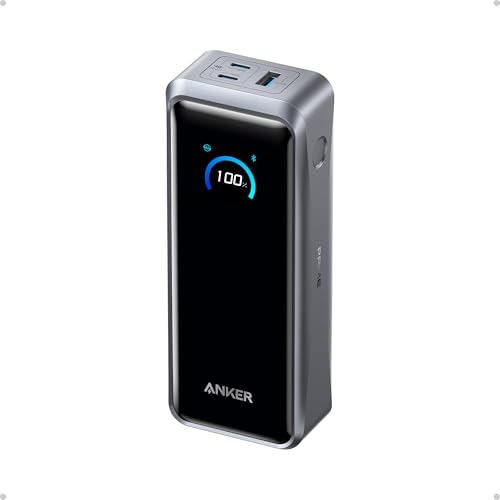
| Anker Prime Power Bank 26,250mAh 300W (99.75Wh) | 26,250 mAh | 99.75 Wh (stated) | 140 W USB-C (with a 5 A cable) | 300 W across 2 USB-C + 1 USB-A | Up to 250 W input using both USB-C ports | 3.3 ft 240 W USB-C cable in the box |
| Baseus Picogo AM52 MagSafe Power Bank, Qi2.2 25W 10,000mAh | 10,000 mAh | Not stated | 25 W wireless (Qi2.2); 45 W built-in USB-C cable | Not stated | Not stated | Built-in 45 W USB-C cable (doubles as strap) |
Which power bank for you
Anker Power Bank 20,000mAh 87W, Built-In USB-C Cable20,000 mAh · 65 W to a single deviceOne pack for the phone, the tablet and a small laptop. Anker states a 14-inch MacBook Pro to 50% in under 40 minutes, and through the built-in cable an iPhone 15 Pro to 58% or a MacBook Air to 52% in 30 minutes. Three ports, and the listing says it is approved for airline travel.Watch out: The listing gives no Wh figure, so read the label on the pack before you fly. A laptop that wants more than 65 W will charge slower than on its own charger. The What You Get line lists no wall charger; warranty is 18 months.Check price on Amazon.ca ↗Anker Nano Power Bank 10,000mAh 45W, Smart Display10,000 mAh · 45 W USB-CThe one that lives in a coat pocket. A retractable 2.3 ft cable rated for over 20,000 bends, a display that shows what is left, pass-through charging, and an iPhone 16 Pro to 50% in 27 minutes as listed. Anker says it is 16% smaller than standard models and flight-approved.Watch out: 10,000 mAh is a phone pack: a day of top-ups, not a laptop charge. The listing describes a 45 W single-port USB-C output, so plan on one device at a time. No Wh figure is stated.Check price on Amazon.ca ↗INIU Power Bank 20,000mAh 45W, Built-In Cable and Flashlight20,000 mAh · 45 WA 20,000 mAh pack for the kitchen drawer, with a built-in flashlight for the first minutes of an outage. INIU states about 4 full phone charges or 2 tablet charges, an iPhone 17 Pro from 20% to 76% in 30 minutes, and a weight of 326.1 g. Listed as flight-safe and airline-approved.Watch out: 45 W is phone and tablet speed, not laptop speed. The listing gives no recharge time, no input wattage and no Wh figure.Check price on Amazon.ca ↗UGREEN 20,000mAh 145W Laptop Power Bank, Built-In Cable (72Wh)20,000 mAh · 100 W USB-CA laptop pack that tells you its watt-hours up front, which is the number an airline asks about. Up to 100 W from one USB-C port, or 100 W plus 45 W to run two laptops at once. Supports PD, PPS, SCP and UFCS fast charging, and charges three devices together.Watch out: The listing states no charge counts and no recharge time. At 72 Wh it is well inside the 100 Wh carry-on line, but 20,000 mAh will not fully recharge a large laptop more than once.Check price on Amazon.ca ↗Anker Laptop Power Bank 25,000mAh 165W, Built-In Retractable Cables25,000 mAh · 100 WThe pack for a family trip or a week of remote work: three 100 W USB-C outputs, and four devices at once counting the two built-in cables, a USB-C and a USB-A port. Anker says it complies with 100 Wh airline restrictions. A protective pouch is in the box.Watch out: 165 W is the total, shared: three laptops do not each get 100 W at the same time. No charger is included, per the listing. Warranty is 18 months.Check price on Amazon.ca ↗Anker Prime Power Bank 26,250mAh 300W (99.75Wh)26,250 mAh · 140 W USB-C (with a 5 A cable)For a MacBook Pro or a gaming laptop that wants serious wattage: up to 140 W from one port, 300 W in total, and a MacBook Pro (M4 Pro) to 50% in 27 minutes as listed. A display and an app show and adjust the output. Travel pouch and a 24-month warranty.Watch out: 99.75 Wh is just under the 100 Wh carry-on line, and Anker says it charges a MacBook Pro (M4) up to 0.8 times: less than one full laptop charge. The charging base shown is not included. Anker notes its figures come from internal lab testing.Check price on Amazon.ca ↗Baseus Picogo AM52 MagSafe Power Bank, Qi2.2 25W 10,000mAh10,000 mAh · 25 W wireless (Qi2.2); 45 W built-in USB-C cableSnaps onto the back of an iPhone 12 or newer and charges without a cable. Baseus states certified 25 W Qi2.2 charging for iPhone 18, 17 and 16, an iPhone 17 Pro to 50% in 34 minutes, a 0.6-inch slim body and a surface kept below 36.2 °C (97 °F) by its own claim.Watch out: iPhone 12 to 15 charge at 15 W at most, per the listing. Wired charging takes priority: you press the power button once to charge two devices. The title says iPhone only for the magnetic fit; no recharge time is stated.Check price on Amazon.ca ↗

Power banks on a plane: the Canadian rules
CATSA, which screens passengers at Canadian airports, is clear on the main point: keep all batteries and battery-powered devices on you or in your carry-on. A spare battery, which is what a power bank is, does not go in checked baggage unless the airline approves.
| Power bank rating | Carry-on | Checked baggage | Source |
|---|---|---|---|
| Under 100 Wh | Yes | Check with carrier | CATSA, portable charger under 100 Wh |
| 100 to 160 Wh | Yes, a maximum of two, with airline approval | Check with carrier | CATSA, portable charger 100 to 160 Wh |
| Over 160 Wh | No | Check with carrier | CATSA, portable charger over 160 Wh |
All seven listings present the pack as fit for carry-on: the UGREEN at 72 Wh, the Anker Prime at 99.75 Wh, the Anker 165W stated as compliant with 100 Wh limits, and the Anker 87W, Anker Nano, INIU and Baseus each described by their listings as flight-approved, flight-safe or within airline guidelines. Read the Wh on the label to be sure. CATSA’s item pages: portable charger under 100 Wh, portable charger 100 to 160 Wh and portable charger over 160 Wh. CATSA also suggests taping over a loose battery’s contacts or keeping it in its packaging or a separate bag. Your airline can be stricter than the screening rules, so check its page before you fly, especially on a connection abroad.
Power banks in the cold
Lithium-ion batteries give less when they are cold. A power bank left in a car overnight in January can show a low charge and deliver less than it would at room temperature, and it recovers as it warms up. Charging a lithium battery that is very cold is also harder on it, which is why manufacturers set a charging temperature range in the manual.
None of the seven listings here states an operating or charging temperature, so we give no number. The practical rules: carry the pack in an inside pocket, not an outside one, on a winter walk or a ski hill; keep the outage pack in the house, not the garage; and let a cold pack warm up indoors before you plug it in to recharge.
A power bank for a Hydro-Québec outage
In an outage, the phone is the most important thing in the house: it is how you check the Hydro-Québec outage map, read the estimated restoration time and reach family. INIU states about 4 full phone charges for its 20,000 mAh pack, and its built-in flashlight covers the first minutes in the dark.
- Keep it charged. A power bank in a drawer slowly loses charge. Top it up when you change the clocks or test the smoke alarm.
- Keep a cable with it. The built-in cables on the Anker, INIU, UGREEN and Baseus picks solve the classic outage problem: the pack is charged, the cable is somewhere else.
- Turn the phone’s brightness down and switch to low-power mode early; the pack lasts longer.
- Recharge it from the car if the outage runs long, with a USB-C car charger, while the car is running outside, never in a closed garage.
Power bank vs portable power station
They are the same idea at different sizes. A power bank fits a pocket or a bag, charges over USB, and is sized for phones, tablets and laptops. A portable power station is a much larger battery in a carry case, usually with AC wall outlets, made for a fridge, a sump pump, a CPAP, a modem and lights during an outage, or a weekend at the cottage.
| Power bank | Portable power station | |
|---|---|---|
| Outputs | USB-C, USB-A, sometimes wireless | AC outlets plus USB and 12 V, depending on the model |
| Best for | Phones, tablets, laptops, earbuds | Appliances and medical devices during an outage |
| Flying | Carry-on, under 100 Wh without airline approval | Over 160 Wh is not permitted in carry-on, per CATSA |
| Where it lives | Pocket, bag, kitchen drawer | Basement, garage, car trunk |
If the question is “what keeps the fridge cold,” a power bank is the wrong tool. Our guide to the best portable power stations in Canada compares them on capacity and output, and many households keep one of each.
The best power bank for travel and winter trips
For a flight, choose a pack with its Wh rating on the label and keep it in your carry-on. For a ski day or a winter road trip, smaller and warmer beats bigger: a 10,000 mAh pack in an inside pocket stays useful, a 25,000 mAh pack in a frozen car does not. For the car itself, a USB-C car charger keeps the pack topped up between stops. Phones drain faster in the cold, so a pack with a built-in cable saves digging for one with gloves on.
Where to buy a power bank in Canada
| Retailer | Strength | Note |
|---|---|---|
| Amazon.ca | Widest range: Anker, UGREEN, INIU, Baseus, magnetic and laptop packs | Check the Wh and the per-port wattage on the listing, not only the mAh |
| Electronics stores | May carry Anker, Belkin and mophie packs | Range varies by store |
| Canadian Tire and hardware stores | May carry power banks next to outage and car gear | Range varies by store and by season |
Frequently asked questions
What is the best power bank in Canada?
For most people, the Anker 20,000 mAh 87W with its built-in USB-C cable: enough for several phone charges and 65 W for a small laptop, as listed. For a pocket, the Anker Nano 10,000 mAh. For a big laptop, the Anker Prime 26,250 mAh (99.75 Wh, 140 W per port). All were in stock on Amazon.ca on November 24, 2026.
Can I bring a power bank on a plane in Canada?
Yes, in your carry-on. CATSA allows power banks under 100 Wh in carry-on, and a maximum of two between 100 and 160 Wh with airline approval. Spare batteries do not go in checked baggage unless the airline approves. Check your airline too, since its own rules can be stricter.
How do I convert mAh to Wh?
Multiply the mAh by the voltage and divide by 1,000, as CATSA explains. The UGREEN 20,000 mAh pack here is listed at 72 Wh, which works out to 3.6 V; the Anker Prime at 26,250 mAh and 99.75 Wh works out to 3.8 V. The exact voltage and Wh rating are printed on the pack's label.
Is 10,000 or 20,000 mAh better?
10,000 mAh fits a pocket and covers a day of phone use. 20,000 mAh is heavier but holds more: INIU states about 4 full phone charges for its 20,000 mAh pack. For a laptop, choose 20,000 mAh or more with at least 65 W of USB-C output.
Can a power bank charge a laptop?
If it has a USB-C Power Delivery port with enough wattage and the laptop charges by USB-C. Match the pack's per-port wattage to the laptop's charger: 65 W on the Anker 20,000 mAh, 100 W on the UGREEN 145W and Anker 165W, 140 W on the Anker Prime with a 5 A cable.
Do power banks work in the cold?
Lithium-ion batteries give less in the cold and recover as they warm up. None of the seven listings states an operating or charging temperature, so keep the pack in an inside pocket in winter, let it warm to room temperature before recharging it, and check the manual for its temperature range.
Is a MagSafe power bank worth it?
If you have an iPhone 12 or newer and want to charge without a cable. Wireless is convenient but generally slower than a cable: the Baseus Picogo states 25 W on iPhone 16 to 18 and 15 W at most on iPhone 12 to 15, while its built-in cable is rated 45 W.
Power bank or portable power station for an outage?
A power bank charges phones, tablets and laptops over USB. A portable power station has a much larger battery and AC outlets for things that plug into the wall. For a long Hydro-Québec outage with a fridge or medical device, you need a power station or a generator.
Keep reading
For a bigger battery that runs appliances in an outage, see the best portable power stations in Canada. To follow an outage as it happens, open the Hydro-Québec outage map.