
Top choices
Specs as stated on the manufacturers' listings; the price shows on the retailer's page.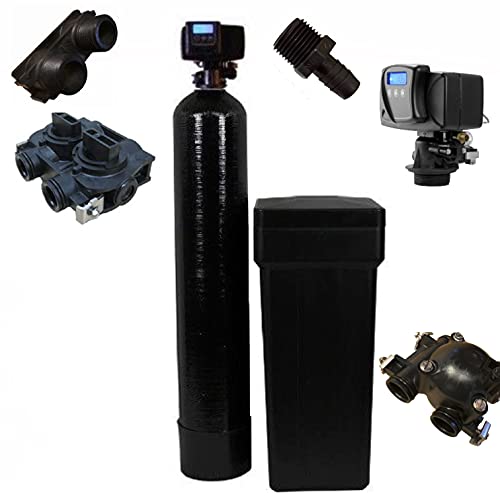 Smaller home · 32,000 grainsFleck 5600 SXT Water Softener, 32,000 GrainsFor a condo, a bungalow or a couple: the same metered on-demand Fleck valve in a smaller size. It is the only softener here whose listing states both city and well water, and the clearest warranty of the group, five years on the valve and ten years on the tanks. Male threaded bypass and paddlewheel meter included.Watch out: Too small for a large family on very hard water: it will regenerate more often. The listing does not state the resin volume. No iron-removal claim, unlike the Iron Pro below.Check price on Amazon.ca ↗
 Large household · 64,000 grainsFleck 5600 SXT Water Softener, 64,000 Grains, Fine Mesh ResinFor a big household or very hard water: 64,000 grains on 2 cubic feet of upgraded fine mesh resin, pre-loaded, with an 18 x 33 inch brine tank and safety float and a stainless bypass valve, as listed. More capacity means fewer regenerations between salt top-ups.Watch out: Bigger tanks need more floor space near the main water line. The listing states no warranty and does not say how much iron the fine mesh resin handles; for a well with iron, the Iron Pro below states its limits.Check price on Amazon.ca ↗
- Well water with iron · 48,000 grainsIron Pro 48K Water Softener & Iron Filter (Fleck 5600SXT)For a rural home on a private well, where orange stains and hardness come together: the listing says it removes hardness, iron up to the 6 to 8 ppm range, manganese up to 6 ppm, plus sediment, sand and rust, and is sized for 2 to 5 people and 2 to 3 bathrooms. DIY instructions and a bypass valve are included.Watch out: Have the well water tested before you buy: iron above the stated range, sulphur smell or bacteria need other treatment. The warranty term is not stated.Check price on Amazon.ca ↗
Hard water is water carrying a lot of dissolved calcium and magnesium. It is not a health hazard: Health Canada's 2025 drinking water guidance says hardness, calcium and magnesium have a low potential for toxicity, and sets no maximum for hardness. It is a nuisance and a maintenance cost: white scale in the kettle and on shower glass, spots on dishes, soap that will not lather, and scale building up inside the water heater. Health Canada notes that water above 200 mg/L is considered poor, though consumers tolerate it.
The short answer
- Most family homes: the Fleck 5600 SXT at 48,000 grains, metered on demand, resin pre-loaded.
- Condo, bungalow, couple: the 32,000-grain Fleck, with a stated 5-year valve and 10-year tank warranty. Big household or very hard water: the 64,000-grain Fleck with fine mesh resin.
- Private well with iron: the Iron Pro 48K, which states iron up to 6 to 8 ppm and manganese up to 6 ppm.
- No salt, no drain, no outlet: the A. O. Smith descaler, which reduces scale but does not soften. Renting: a shower filter like the AquaBliss SF100.
How we picked, and what we did not do: we have not installed or lab-tested any of these units. We looked for whole-house softeners actually in stock in Canada, then ranked them on what their Amazon.ca listings state: grain capacity, resin volume, valve type, regeneration, city or well water, iron limits and warranty. Every product on a card was in stock on November 26, 2026; Aquasure, iSpring, Kenmore and several others were only available with a delay or in short supply that day, and we found no Whirlpool, Culligan or Pelican softener in stock, so they are not on a card. Where a listing leaves a number out, we write “not stated”. Health statements come only from Health Canada. Links to Amazon are affiliate links; BranchéQC may earn a commission at no extra cost to you. We do not write prices by hand.
How does a water softener work?
A salt-based softener works by ion exchange. Water from the main line runs through a tank of resin beads that hold sodium. Calcium and magnesium stick to the resin and sodium takes their place, so the water leaving the tank is soft. When the resin is full, the valve runs a regeneration: it draws salty water (brine) from the second tank, flushes the hardness off the resin and sends that rinse water to the drain.
The valve decides when that happens. A metered, on-demand valve like the Fleck 5600 SXT counts the water you use and regenerates only when the resin has done its work, which is why the listings call it efficient on salt and water. A timer valve regenerates on a fixed schedule whether you used the water or not.
Do you need a water softener? Test your water first
Hardness depends on where your water comes from. The City of Montreal explains that the source and the type of minerals in the soil determine the hardness of the water, and points residents to its annual drinking water quality reports for the average hardness on the island (montreal.ca). Other Canadian cities publish similar reports; your municipality's water report is the first place to look. On a private well, only a test will tell you, and a lab test also shows iron and manganese.
For a quick home reading, a strip kit like the Varify water hardness test kit reads from 0 to 25 grains per gallon (0 to 425 ppm) against a colour chart, with 150 strips, as listed. If your kettle scales up within weeks and soap barely lathers, you will likely read well above the soft end.
What size water softener do I need? Grain capacity explained
Softeners are rated in grains: how much hardness the resin can remove before it needs to regenerate. Sizing takes three numbers you can find:
- Your hardness in grains per gallon (gpg). Lab and city reports use mg/L as calcium carbonate; divide by 17.1 to get gpg.
- Gallons used per day. From your water meter if you have one; otherwise ask the installer for an estimate for your household.
- Days between regenerations you are aiming for, often about a week.
Multiply them: hardness x gallons per day x days = grains needed between regenerations. A worked example with round numbers: 10 gpg x 300 gallons a day x 7 days = 21,000 grains, which sits well inside a 32,000-grain unit and leaves a 48,000-grain one plenty of margin. Add margin if you have iron, because iron also loads the resin.
| Situation | Capacity to look at | Pick in this guide |
|---|---|---|
| Condo, bungalow, 1 to 2 people, moderate hardness | 32,000 grains | Fleck 5600 SXT 32,000 |
| Family home, 3 to 5 people | 48,000 grains | Fleck 5600 SXT 48,000 |
| Large household or very hard water | 64,000 grains | Fleck 5600 SXT 64,000 or VEVOR 64,000 |
| Private well with iron and manganese | 48,000 grains, fine mesh resin | Iron Pro 48K (2 to 5 people, as listed) |
The eight picks, compared on published specs
Every figure is the maker’s own. Where a listing gives no number, the table says so rather than guessing.
| Model | Type | Capacity | Resin | Regeneration | Power | Water | Warranty |
|---|---|---|---|---|---|---|---|
| Fleck 5600 SXT Water Softener, 48,000 Grains | Salt-based ion exchange | 48,000 grains | 1.5 cu ft, pre-loaded | On demand, digital metered | Not stated (digital valve) | Not stated | Not stated |
| Fleck 5600 SXT Water Softener, 32,000 Grains | Salt-based ion exchange | 32,000 grains | Not stated, pre-loaded | On demand, metered (paddlewheel) | Not stated (digital valve) | City and well | 5 yr valve, 10 yr tanks |
| Fleck 5600 SXT Water Softener, 64,000 Grains, Fine Mesh Resin | Salt-based ion exchange | 64,000 grains | 2 cu ft fine mesh, pre-loaded | Digital metered | Not stated (digital valve) | Not stated | Not stated |
| Iron Pro 48K Water Softener & Iron Filter (Fleck 5600SXT) | Salt-based, fine mesh resin | 48,000 grains | Fine mesh, volume not stated | Digital metered | Not stated (digital valve) | Hardness, iron, manganese | Manufacturer warranty, term not stated |
| VEVOR Water Softener, 64,000 Grains | Salt-based ion exchange | 64,000 grains | 2.12 cu ft | Digital, every 8 to 30 days | Not stated (digital head) | Not stated | Not stated |
| A. O. Smith Salt-Free Whole House Descaler (AO-WH-DSCLR) | Salt-free scale reduction | 6 years or 600,000 gal | Not applicable | None (no backwash) | None required | City and well | Limited 6 years |
| AquaBliss SF100 Shower Filter | Shower filter (not a softener) | Cartridge 3 to 6 months | Not applicable | Replace cartridge | None | Shower only | Not stated |
| Jolie Filtered Showerhead | Filtered showerhead (not a softener) | Not stated | Not applicable | Replace filter | None | Shower only | Not stated |
The best water softener systems for your home
Fleck 5600 SXT Water Softener, 48,000 GrainsSalt-based ion exchange · 48,000 grainsThe middle size that fits most family homes on hard city water: Fleck's 5600 SXT digital valve meters the water you use and regenerates on demand, so it does not waste salt on a fixed schedule. The listing says 1.5 cubic feet of high-capacity resin ships already loaded in the black mineral tank, with a brine tank and safety float and a 1-inch Noryl bypass.Watch out: The listing states no warranty, no household size and nothing about city versus well water. Manuals in French are not mentioned. It is a two-tank system that needs floor space, a drain and a plumber.Check price on Amazon.ca ↗Fleck 5600 SXT Water Softener, 32,000 GrainsSalt-based ion exchange · 32,000 grainsFor a condo, a bungalow or a couple: the same metered on-demand Fleck valve in a smaller size. It is the only softener here whose listing states both city and well water, and the clearest warranty of the group, five years on the valve and ten years on the tanks. Male threaded bypass and paddlewheel meter included.Watch out: Too small for a large family on very hard water: it will regenerate more often. The listing does not state the resin volume. No iron-removal claim, unlike the Iron Pro below.Check price on Amazon.ca ↗Fleck 5600 SXT Water Softener, 64,000 Grains, Fine Mesh ResinSalt-based ion exchange · 64,000 grainsFor a big household or very hard water: 64,000 grains on 2 cubic feet of upgraded fine mesh resin, pre-loaded, with an 18 x 33 inch brine tank and safety float and a stainless bypass valve, as listed. More capacity means fewer regenerations between salt top-ups.Watch out: Bigger tanks need more floor space near the main water line. The listing states no warranty and does not say how much iron the fine mesh resin handles; for a well with iron, the Iron Pro below states its limits.Check price on Amazon.ca ↗Iron Pro 48K Water Softener & Iron Filter (Fleck 5600SXT)Salt-based, fine mesh resin · 48,000 grainsFor a rural home on a private well, where orange stains and hardness come together: the listing says it removes hardness, iron up to the 6 to 8 ppm range, manganese up to 6 ppm, plus sediment, sand and rust, and is sized for 2 to 5 people and 2 to 3 bathrooms. DIY instructions and a bypass valve are included.Watch out: Have the well water tested before you buy: iron above the stated range, sulphur smell or bacteria need other treatment. The warranty term is not stated.Check price on Amazon.ca ↗VEVOR Water Softener, 64,000 GrainsSalt-based ion exchange · 64,000 grainsIf you would rather not buy a Fleck valve: VEVOR lists 2.12 cubic feet of resin, a digital control head that runs backwash, brine draw and refill on its own, a bypass valve, polyethylene tanks, and sizing for 5 to 7 people and 5 to 6 bathrooms. VEVOR says it removes over 90% of calcium and magnesium ions, a maker's figure we did not test.Watch out: The listing says high-purity salt blocks; check the manual for which salt it accepts. It ships in separate packages, and the warranty and valve brand are not stated.Check price on Amazon.ca ↗
Alternatives: salt-free conditioner and shower filters
These three are not whole-house softeners. They are here because they solve a narrower problem with less plumbing, and because they are what most people end up buying when they rent or have no floor space by the main line.
A. O. Smith Salt-Free Whole House Descaler (AO-WH-DSCLR)Salt-free scale reduction · 6 years or 600,000 galFor someone who wants less scale in pipes and appliances with no salt bags, no drain line and no outlet: the listing says no cleaning, backwashing, salt or electricity is required, it works on city and well water, suits households of 4 or more, and lasts up to 6 years or 600,000 gallons with a 6-year warranty. Shut-off valve and fittings included.Watch out: It is not a softener: A. O. Smith says it reduces scale build-up and will not reduce TDS, sulphur or iron. The calcium and magnesium stay in the water, so expect less change on soap, spots and laundry than with ion exchange.Check price on Amazon.ca ↗AquaBliss SF100 Shower FilterShower filter (not a softener) · Cartridge 3 to 6 monthsFor an apartment where you cannot touch the plumbing: it threads between a standard 1/2-inch shower arm and your existing shower head, by hand, with thread seal tape included. AquaBliss lists calcium sulfite, redox media and activated carbon to reduce chlorine, sediment and odours, with one cartridge lasting 3 to 6 months depending on your water.Watch out: It treats the shower only, and the listing does not claim to remove calcium or magnesium, so it will not stop scale on the kettle or the dishwasher. Leave the original shower head in a drawer to put back when you move.Check price on Amazon.ca ↗Jolie Filtered ShowerheadFiltered showerhead (not a softener) · Not statedIf you would rather replace the whole shower head than add a cartridge under it: Jolie lists a blend of KDF-55 and calcium sulfite to remove chlorine and heavy metals, a soft faceplate, and installation on a standard 1/2-inch NPT shower arm with instructions included.Watch out: Jolie itself says it may not fit custom plumbing and that over-tightening can cause leaks. Filter life is not stated in the listing, and like any shower filter it does not soften the rest of the house.Check price on Amazon.ca ↗


Salt-based softener vs salt-free water conditioner
A salt-based softener removes the calcium and magnesium. That is what changes how the water feels, how soap lathers and how fast scale forms. It needs salt, a drain for the regeneration water and, on digital valves, power.
A salt-free conditioner leaves the minerals in the water and aims to stop them from sticking as scale. The A. O. Smith descaler lists no salt, no backwash and no electricity, and says plainly that it will not reduce TDS, sulphur or iron. An electronic descaler is another approach: the iSpring ED2000 wraps around the pipe with no plumbing changes, is described by iSpring as “different from a water softener” and is designed for 10 to 19 grains per gallon, as listed. If the goal is the best water conditioner for a cottage with no drain, these make sense; if the goal is soft water, choose ion exchange.
Can you drink softened water?
Health Canada's guidance on drinking water operational parameters says that softening by sodium ion exchange may introduce undesirably high levels of sodium into drinking water, and recommends that the water consumed most often, such as the kitchen tap, bypass the softener altogether (Health Canada, March 2025). In practice: ask your plumber to leave the kitchen cold tap, and the fridge water line if you have one, on unsoftened water.
Does a water softener remove chlorine?
No. A softener targets hardness minerals, and none of the five softener listings in this guide claims to remove chlorine. Chlorine and chloramine are what the shower filters list: AquaBliss names calcium sulfite, redox media and activated carbon, Jolie a blend of KDF-55 and calcium sulfite. Removing chlorine for the whole house is the job of a separate carbon filter.
Best water softener for well water
Rural homes across Canada draw from private wells, and well water often brings iron or manganese along with hardness: orange stains in the toilet, rusty laundry. A standard softener resin can foul with iron. The Iron Pro 48K uses fine mesh resin and states iron removal up to the 6 to 8 ppm range and manganese up to 6 ppm, and the 32,000-grain Fleck states city and well water. Keep a resin cleaner on hand: Res Care Rust Out is listed for heavy iron build-up, used by layering 4 oz between each bag of salt. Above the stated iron range, or with a sulphur smell, talk to a water treatment specialist before buying.
How to install a water softener: plumber, drain and outlet
A whole-house softener goes on the main water line, after the meter or the well pressure tank and before the water heater, with a bypass valve so you can switch it off without cutting the water. Three practical needs decide where it goes:
- A drain nearby for the regeneration water, usually the floor drain or a laundry standpipe in the basement.
- A standard outlet nearby for a digital valve such as the Fleck SXT or the VEVOR head. The A. O. Smith descaler needs none.
- A heated room. In a Canadian winter, an unheated garage or crawl space can freeze the brine line and the valve. Keep it in the heated basement or utility room.
Some listings ship DIY instructions or videos, but this is plumbing on your main supply. In Quebec, plumbing work is regulated: hire a plumbing contractor who holds a licence from the Régie du bâtiment du Québec, which you can check with our RBQ licence checker. The CMMTQ (Corporation des maîtres mécaniciens en tuyauterie du Québec) publishes a directory of its members. Elsewhere in Canada, use a licensed plumber and ask whether a permit applies.
Water softener maintenance: salt, resin and cleaning
- Salt. Check the brine tank monthly and keep it topped up. Morton sells Clean and Protect II pellets and Pure and Natural solar salt crystals in 40-pound bags; Morton lists the crystals as working in all water softeners. Use what your manual specifies.
- Salt bridges. In humid basements, salt can crust over above the water. If the salt level never drops, break the crust gently with a broom handle.
- Resin cleaning. A softener cleaner keeps the resin working, especially with iron; follow your manual for how often and which product.
- Power outages. After a long outage, check the clock and settings on a digital valve.
How long does a water softener last?
The warranties on these listings give the best published clue. The 32,000-grain Fleck states five years on the valve and ten on the tanks, and the A. O. Smith descaler states up to six years or 600,000 gallons with a six-year warranty. Iron and sediment can foul the resin over time, which is one reason to clean it on the schedule in the manual and, on a well, to deal with iron properly.
Water softener brands sold in Canada
Fleck is a control valve, not a whole system: sellers such as DuraWater build complete softeners around the 5600 SXT, and one DuraWater listing mentions Pentair's Scan and Service app. VEVOR sells its own complete system. Aquasure, iSpring and Kenmore softeners appear on Amazon.ca but were delayed or scarce on November 26, 2026. Whirlpool and Rainfresh show up mostly at home improvement stores, while Culligan and Kinetico work mainly through their own dealers, which install and service the unit.
Where to buy a water softener in Canada
| Where | Strength | Note |
|---|---|---|
| Amazon.ca | Fleck-based systems, VEVOR, salt-free units, salt, test strips | Stock changes fast; check the grain size and the bypass size (3/4 or 1 inch) |
| Home improvement stores | Whirlpool, Rainfresh and salt in store | Range varies by store; ask about installation |
| Water treatment dealers | Installation, service, water testing | Culligan, Kinetico and local dealers; compare a written quote |
Frequently asked questions
What is the best water softener in Canada?
For most homes on hard city water, a 48,000-grain Fleck 5600 SXT: a metered on-demand valve that regenerates only when needed, with 1.5 cubic feet of resin pre-loaded, as listed. Pick 32,000 grains for a small home, 64,000 for a large one, and the Iron Pro 48K for a well with iron. All were in stock on Amazon.ca on November 26, 2026.
What size water softener do I need?
Multiply your hardness in grains per gallon by the gallons your home uses per day, then by the days you want between regenerations. Convert a lab result in mg/L to grains per gallon by dividing by 17.1. Pick a unit whose rated capacity is comfortably above that number, and let the installer program the valve with your measured hardness.
Salt-based water softener or salt-free conditioner?
A salt-based softener removes calcium and magnesium by ion exchange; a salt-free conditioner leaves them in the water and aims to reduce scale. A. O. Smith's descaler listing says it needs no salt, backwash or electricity, but will not reduce TDS, sulphur or iron. If you want soft-feeling water, fewer soap spots and protection for the water heater, ion exchange does more.
Can you drink water from a water softener?
Health Canada says softening by sodium ion exchange may add undesirably high levels of sodium to drinking water, and recommends that the water you drink most, such as the kitchen tap, bypass the softener altogether. Ask your plumber to leave the kitchen cold tap on unsoftened water.
Does a water softener remove chlorine?
No, not by itself. Ion exchange targets hardness minerals, and none of the softener listings here claims chlorine removal. Chlorine is what the shower filters in this guide list, and a whole-house carbon filter is a separate system.
What is the best water softener for well water?
If the well has iron as well as hardness, a combination unit like the Iron Pro 48K, whose listing states iron removal up to the 6 to 8 ppm range and manganese up to 6 ppm. Test the well first: sulphur smell, bacteria or iron above that range call for other treatment.
How do I clean and maintain a water softener?
Keep salt in the brine tank, check it monthly, and break up any salt bridge. Use the salt and resin cleaner your manual allows: Res Care Rust Out is listed for iron build-up, layered 4 oz between bags of salt. Keep the unit in a heated room, since a frozen brine line or valve will stop it.
Can I install a water softener myself?
Some listings include DIY instructions, but the softener ties into your main water line and needs a drain for regeneration water and, for digital valves, a nearby outlet. In Quebec, plumbing work is regulated: hire a plumbing contractor holding an RBQ licence; the CMMTQ publishes a directory of its members.
How much does a water softener cost?
We do not write prices by hand, because Amazon prices change daily: use the Check price button on each card. Budget for more than the unit: installation by a plumber, bypass and drain fittings, and salt on an ongoing basis for a salt-based softener.
Keep reading
For drinking water at the kitchen tap, our guide to the best reverse osmosis system in Canada compares tank and tankless under-sink units.
Softening is not filtering: for chlorine taste, sediment or well water, see our guide to the best whole house water filter in Canada.
Protecting the basement? Our guides to the best water leak detector and the best basement dehumidifier in Canada compare models on what each listing states.
Hard water is hardest on appliances that heat it. See our guides to the best electric kettle, espresso machine and humidifier in Canada, each with its own descaling advice.