
Best Humidifier in Canada (2026): Bedroom to Whole House
Specs checked November 3, 2026 · Version française
Most humidifier round-ups are written for a climate where winter means a light jacket. Here it means weeks below minus 15, a furnace or baseboards running around the clock, and indoor air that feels like a hotel room. The right machine depends on three things, in this order: how hard your tap water is, how big the space is, and whether your house has ducts. And whatever you buy, your windows set the ceiling, not the dial.
The short answer
- Bedroom or nursery: a quiet cool mist unit, 2.5 to 4 litres, top fill, lights off at night.
- Hard tap water: an evaporative model. No white dust, but budget for wicks.
- Living room or open plan: a 6 to 10 litre tank, or a console if the space is really large.
- Whole house with ducts: a furnace humidifier, installed by a pro. Without ducts: a console plus a bedroom unit.
- Everyone: a hygrometer. Water on the windows means turn it down.
How we picked, and what we did not do: we have not bench-tested these machines. Every specification on this page is quoted from the manufacturer’s own Amazon.ca listing, checked November 3, 2026, and every unit was confirmed in stock in Canada that day. Where a listing contradicts itself or leaves a key figure out, the card says so. Links to Amazon are affiliate links; BranchéQC may earn a commission at no extra cost to you. We do not publish prices by hand; the Amazon page is what counts.
Why Canadian winter air is so dry indoors
Cold air simply cannot hold much water. A January day can feel damp outside, but the absolute amount of moisture in that air is tiny. Bring it inside, through leaks, an air exchanger or an opened door, and heat it to 21 °C: the same water is now spread across air that could hold far more, so its relative humidity collapses. That happens with any heating system. Baseboards, a gas furnace and a heat pump all warm the air without adding a drop.
The symptoms are familiar: a scratchy throat on waking, cracked lips, static shocks off every door handle, and hardwood floors that open gaps along the boards. A humidifier does not fix the cause, which is the climate. It replaces the water the heating season takes away.
What humidity to aim for, and the window limit
The range commonly advised for homes is roughly 30 to 50 percent relative humidity. In a Canadian winter, the top of that range is usually out of reach for a practical reason: windows. The colder it is outside, the colder the inner face of the glass, and the sooner water condenses on it. Water running down the bottom of the pane, or frost along the frame, is a reading in itself. It says the air is already too humid for the outdoor temperature.
The usual guidance is to stay around 30 to 40 percent in deep cold, drifting lower when it drops past minus 20, and to let it climb a little in milder weeks. You cannot do that by feel. A cheap hygrometer in the bedroom and another near the coldest window turns guessing into reading a number. And if your windows stream even with no humidifier running, the problem is ventilation, not dryness: the bathroom fan, the range hood or the air exchanger. Adding moisture would only make it worse.
Evaporative vs ultrasonic vs warm mist
All three put the same water in the air. What changes is noise, running cost, safety and how they deal with minerals.
| Type | How it works | Strength | Trade-off |
|---|---|---|---|
| Ultrasonic (cool mist) | A vibrating plate shakes water into fine droplets | Near silent, low power, usually no filter | Hard water leaves white dust |
| Evaporative | A fan pushes air through a wet wick | No white dust; output falls as the room gets humid | Fan sound, wicks to replace |
| Warm mist (steam) | Boils water into vapour | Minerals stay in the unit | More electricity, hot vapour |
Ultrasonic is the bedroom default: quiet and cheap to run. Its weakness is hard water. The plate turns dissolved calcium into droplets too, and it settles on furniture as white powder. Distilled water or a demineralization cartridge reduces it.
Evaporative models are self-limiting: as the room gets more humid, less water leaves the wick, so they are harder to over-run. The wick catches the minerals, which is why there is no dust and why it hardens and needs replacing.
Warm mist boils water, so minerals stay behind as scale in the unit. It uses noticeably more power, and the vapour is hot: not a machine for a toddler’s room or a spot a dog can knock over.
How big: sizing by room
Coverage on a listing is the manufacturer’s figure, not a promise. The tank decides how often you refill, which in practice decides whether you keep using it. A bedroom unit in an open plan runs flat out and never reaches the target.
| Space | Rough size | What to look for |
|---|---|---|
| Bedroom, office | Up to about 270 sq ft | 2.5 to 4 L tank, sleep mode |
| Living room, family room | 270 to 450 sq ft | 4 to 6 L tank, auto humidistat |
| Open plan, large room | 450 sq ft and up | 6 to 10 L, or a console |
| Whole house, no ducts | 1,500 sq ft and up | Evaporative console, centrally placed |
| Whole house, with ducts | Every room | Furnace humidifier on the ductwork |
Furnace and whole-house humidifiers
A portable unit treats one room. To humidify the whole house, the moisture has to travel, and the thing that moves air through every room is your ductwork. A furnace humidifier mounts on the supply or return duct, takes water from a supply line, and is driven by a wall or duct humidistat. There are three common designs:
- Bypass. A small duct loops warm air through a wet water panel and back. Simple and common, but it only works while the furnace blower runs, and the bypass is closed in summer if you have central air.
- Fan-powered. Same water panel, with its own fan pushing air through it. More output, no bypass duct, a little more power.
- Steam. Boils water and injects vapour into the duct. The highest output and independent of furnace heat, which matters with a heat pump whose supply air is cooler. Also the most expensive to buy and run.
This is an installer’s job: a water connection, often a drain, and low-voltage wiring to the furnace control. In Quebec, any fixed electrical connection must be made by an RBQ-licensed electrician. The crucial condition is ducts. A house heated by baseboards or a wall-mounted ductless heat pump has nowhere to put one. There, the answer is a console in the main living area plus a small unit in each bedroom you care about. If you are planning a central, ducted heat pump anyway, our page on heat pump installation in Quebec explains the process; ask the installer to quote the humidifier at the same time.
The eight picks, compared on published specs
Every figure below is the manufacturer’s own, from the Amazon.ca listing. Where a listing gives no number, the table says so instead of guessing.
| Model | Type | Tank / output | Stated coverage | Runtime / control |
|---|---|---|---|---|
| Levoit Classic 160, 2.5 L, top fill | Cool mist | 2.5 L | Not stated | Up to 25 h on low |
| Levoit OasisMist 1000S, 10 L, smart | Cool mist, app control | 10 L | Up to 600 sq ft | Up to 100 h |
| Honeywell HEV615 evaporative tower | Evaporative (wick) | 6.44 L (1.7 gal) | “Large rooms”, no sq ft given | Up to 24 h |
| Levoit LV600HH, warm or cool, 6 L | Warm or cool mist | 6 L | Up to 753 sq ft | Up to 60 h on low |
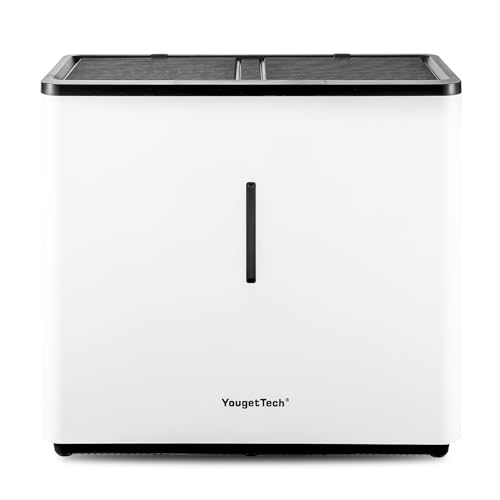
| YougetTech EH22T evaporative console | Evaporative console | 14.5 L (3.9 gal) | Up to 2,125 sq ft | Output up to 3,000 mL/h |
| AprilAire 500 bypass + installation kit | Furnace bypass | 12 gal/day | Up to 3,600 sq ft (see note) | Model 60 automatic humidistat |
| ThermoPro TP157 hygrometer, 2-pack | Hygrometer | n/a | One per room | Battery 18 to 24 months |
| Honeywell HFT600PFC wick, Filter T | Replacement wick | n/a | HEV615BC, HEV615WC, HEV620BC | Replace every 1 to 2 months |
Which one for your home
Levoit Classic 160, 2.5 L, top fillCool mist · 2.5 LA bedroom or a nursery. Top fill, one knob, a 360° nozzle, and noise stated as low as 26 dB with all lights off.Watch out: The listing calls it cool mist but never names the technology, and gives no room size. 2.5 L is one bedroom. Most compact cool mist units are ultrasonic; if this one is, hard tap water can leave white dust, so check the manual.Check price ↗Levoit OasisMist 1000S, 10 L, smartCool mist, app control · 10 LA living room or an open plan. Stated output of 350 mL/h, auto and sleep modes, app schedules and a wide top-fill opening.Watch out: Ten litres of water is heavy to carry to the sink, and the unit is oversized for a small bedroom. Like the Classic 160, the listing describes mist, not the technology.Check price ↗Honeywell HEV615 evaporative towerEvaporative (wick) · 6.44 L (1.7 gal)Hard tap water and no wish to buy distilled. The wicking filter captures minerals, so the moisture is invisible and leaves no white dust. Top fill, auto shut-off.Watch out: Honeywell says to replace the wick every 1 to 2 months for best performance. That is a real running cost over a five-month winter. Expect a fan sound, which is how every evaporative unit works.Check price ↗Levoit LV600HH, warm or cool, 6 LWarm or cool mist · 6 LSomeone who wants warm mist some nights and cool mist the rest, from one machine. Filterless, remote control, auto mode, display off.Watch out: Warm mode heats water, so it draws more electricity and the vapour is hot. Keep it on cool in a child’s room or near pets.Check price ↗YougetTech EH22T evaporative consoleEvaporative console · 14.5 L (3.9 gal)A house with no ducts, heated by baseboards or a ductless heat pump, where one large unit in a central spot beats four small ones.Watch out: The auto humidistat range starts at 40 %, above the 30 to 35 % a house often needs in a deep cold snap to keep windows dry. In January you may run it on a manual speed and watch a hygrometer. The title also says “for Bedroom”, which a 14.5 L console is not.Check price ↗AprilAire 500 bypass + installation kitFurnace bypass · 12 gal/dayA house with a forced-air furnace or a ducted heat pump. The kit bundles the duct collar, bypass duct, water tube, drain tube and wire an installer needs.Watch out: This is an installer job: water line, drain and low-voltage wiring. AprilAire’s own listing for the 500M sold alone says 3,000 sq ft; this kit says 3,600. Size on the lower figure.Check price ↗ThermoPro TP157 hygrometer, 2-packHygrometer · One per roomEvery buyer on this page. Stated accuracy of ±2 to 3 % RH, a reading every 10 seconds. One in the bedroom, one near the coldest window.Watch out: It measures; it does not switch anything on or off.Check price ↗Honeywell HFT600PFC wick, Filter TReplacement wick · HEV615BC, HEV615WC, HEV620BCOwners of the HEV615 above. Honeywell lists the signs it is due: hard and crusty, an odour, or lower output.Watch out: One filter per box, and it fits only the three listed models. Check the model number under your unit first.Check price ↗




How to clean a humidifier
A neglected humidifier sprays whatever grows in its tank into the air you breathe all night. Cleaning takes a few minutes a week. The routine below is generic; your manual is the authority, especially on what can go in water and what cannot.
- Every day: unplug, empty the old water, rinse and refill fresh. Do not top up yesterday’s water.
- Every week: pour white vinegar into the tank and the base reservoir as the manual directs, and let it sit to dissolve scale.
- Scrub with a soft brush, gently around the ultrasonic plate if yours has one.
- Rinse thoroughly so no vinegar smell remains, and let every part air dry before reassembling.
- Never immerse the section that holds the motor or the electronics.
This is where design beats features: a tank opening wide enough for your hand stays clean; a narrow bottle you cannot reach inside will not. In spring, clean it, dry it completely and store it. Summer belongs to the basement dehumidifier, the opposite problem.
Filters, wicks and water panels
Evaporative portables run on a wick that hardens as it collects minerals. Honeywell states every 1 to 2 months for the HEV615, sooner with hard water or if it smells. Ultrasonic units usually need no filter, though some offer an optional demineralization cartridge. Furnace humidifiers use a water panel; AprilAire specifies annual replacement for the 500. Price the replacement before the machine: over several winters, it adds up.
Honeywell, Vicks, Dyson: what the brands mean
Honeywell is the name most people find in Canadian stores, and it sells both evaporative and cool mist models under the same badge: check the box for the technology, because the maintenance differs completely. Vicks is a pharmacy staple with warm and cool mist lines; for a child’s room, pick cool mist. Dyson combines a humidifier, an air purifier and a fan. Worth it if you want all three; otherwise you pay for two functions you will not use. Whatever the badge, the questions stay the same: technology, tank size, a real humidistat and an opening you can clean.
What the American reviews leave out
- The window is the limit. Reviews tested in a mild climate praise units that push a room to 50 percent. In a Canadian cold snap, that is a recipe for wet sills and mould on the frames.
- Humidistat floors matter. An auto mode that cannot be set below 40 percent is less useful here than it looks; check the range before trusting the automatic setting.
- Many houses have no ducts. Baseboard heat and ductless heat pumps are common in Quebec, and they rule out the furnace humidifier most American guides treat as the whole-house default.
- Five months is a long season. A unit that runs from November to March goes through a lot of wicks and a lot of refills. Running cost and ease of cleaning matter more than the launch price.
Where to buy in Canada
| Retailer | Strength | Note |
|---|---|---|
| Amazon.ca | Widest range, including consoles and furnace kits | Compare technology and tank size on the listing |
| Home Depot | Furnace humidifiers and water panels in store | Useful when an installer needs a part the same day |
| Canadian Tire | Seasonal portable range, frequent promotions | Stock peaks in the fall and thins out by February |
| Pharmacies | Vicks and small cool mist units nearby | Limited choice, convenient for a quick replacement |
| Costco | Good value on mid-size units | Selection varies by warehouse and season |
Frequently asked questions
What is the best humidifier for a bedroom?
A cool mist unit with a 2.5 to 4 litre tank, a top fill, a wide opening you can scrub by hand, and a sleep mode that turns the lights off. Look for a stated noise figure in the twenties of decibels. If your tap water is hard and you do not want to buy distilled water, a small evaporative model avoids the white dust at the cost of a fan sound and a wick to replace.
What humidity should a house be in winter in Canada?
The commonly advised range indoors is roughly 30 to 50 percent, but in deep cold the practical ceiling is lower. When it is minus 20 outside, glass is cold enough that water condenses on it well before 50 percent. The usual guidance is to stay around 30 to 40 percent in a cold snap and lower it as soon as you see water or frost at the bottom of a window.
Cool mist or warm mist: which is better?
Both add the same water to the air. Cool mist uses less electricity and has no hot water to spill, which is why it is the usual choice for a child’s room. Warm mist boils water, so it costs more to run and the vapour is hot, but it leaves minerals behind in the unit rather than spraying them into the room.
Why does my humidifier leave white dust?
An ultrasonic humidifier turns all of the water into droplets, including the dissolved minerals in hard tap water. When the droplets evaporate, the minerals settle as a fine white powder. Distilled water or a demineralization cartridge reduces it. Evaporative and warm mist models do not have the problem because the minerals stay in the wick or the tank.
How do I clean a humidifier?
Unplug it, empty it, and rinse the tank every day rather than topping up old water. Once a week, descale the tank and base with white vinegar as the manufacturer’s manual describes, scrub gently, rinse thoroughly and let it air dry. Never immerse the part that holds the motor or electronics. The manual always wins over generic advice, including this answer.
Can I add a humidifier to my heat pump?
Only to a ducted, central heat pump, where a bypass, fan-powered or steam humidifier mounts on the ductwork like it would on a furnace. A wall-mounted ductless heat pump has no ducts to carry moisture, so the answer there is portable units or a console.
How often should I change a humidifier filter?
Follow the manufacturer. Honeywell states every 1 to 2 months for the HEV615 wick, sooner if it turns hard and crusty or develops an odour. A furnace water panel is typically replaced once a year, before the heating season. Hard water shortens both.
Is a Dyson humidifier worth it?
Dyson’s humidifiers combine humidification with air purification and a fan. If you want all three in one machine, that is the case for it. If you only need moisture, you are paying for functions you will not use, and a dedicated humidifier does the job for much less.
Keep reading
Dealing with the opposite problem in July? Our guide to the best basement dehumidifier in Canada explains why a 50-pint unit is not what it used to be. Staying warm without overheating the whole house? See the best heated blankets in Canada and the best space heaters in Canada. Thinking about a central heat pump that could carry a whole-house humidifier? Start with heat pump installation in Quebec.