
Heat Tape and Roof De-Icing Cable in Canada (2026)
Specs checked November 3, 2026 · Version française
“Heat tape” covers two products that only share a plug. One runs along a water pipe and keeps it above freezing. The other zig-zags along the roof edge, through the gutter and down the downspout to open a drain path through the ice. Buy the wrong one and it either melts nothing or wastes power. Here is which is which, which type may overlap, how much cable a roof takes, and what the outlet has to be.
The short answer
- Straight roof edge with gutters: a fixed-length constant wattage kit sized to your measurements, plus a plug-in thermostat.
- Pipe, valley or any run that doubles back: self-regulating cable, the only type allowed to overlap.
- Supply line in a crawl space, mobile home or cottage: a pre-assembled pipe tape with a built-in thermostat, rated for your pipe material.
- Always: a GFCI-protected outdoor outlet under an in-use cover. No indoor extension cord through a window.
- Ice dams every winter: the cable buys time. The fix is in the attic.
How we picked, and what we did not do: we have not installed or bench-tested these products. Every specification is quoted from the manufacturer’s Amazon.ca listing, checked November 3, 2026, when every product was in stock in Canada. Where a listing is silent or contradicts itself, the card says so. Links to Amazon are affiliate links; BranchéQC may earn a commission at no extra cost to you. We do not publish prices by hand; the Amazon page is what counts.
Two different products: pipe heat tape and roof de-icing cable
Pipe heat tape, also sold as heat trace cable, is low power. The HEATIT JHSF on this page is rated 3 W/ft. It lies against the pipe under foam insulation and only replaces the heat the pipe loses. Most pipe products come pre-assembled, and many have a thermostat built in.
Roof and gutter de-icing cable sits in open air, on cold shingles, in snow and meltwater. It needs more output per foot and clips that hold it in a pattern; the HEATIT HIRD roof kits state 5 W/ft. A few self-regulating cables, like the HEATIT 8PLSR, are listed for both jobs. A pipe-only product on a roof will not open a channel.
Constant wattage or self-regulating
A constant wattage cable puts out the same heat along its whole length whenever it is plugged in, at −25 °C or at +3 °C. It comes in fixed lengths that cannot be cut, costs less per foot and suits a straight roof edge. Its hard rule: it must never overlap or touch itself, because where two runs cross the heat doubles and the jacket can fail. The HEATIT HIRD listings say so plainly.
A self-regulating cable changes its resistance with temperature: more heat where it is cold, less where it is already warm. That is what makes overlapping safe, and why the HEATIT 8PLSR and JHSF listings allow overlapped runs. It is the format for pipes, valleys and any run that doubles back. It costs more per foot and still draws some power when it is mild, so a thermostat is still worth having.
The thermostat-controlled plug: the accessory that pays for itself
A roof cable plugged in from October to April spends much of that time heating a roof that is not freezing: November rain, March thaws, sunny afternoons. A thermostatically controlled outlet sits between the wall outlet and the cable plug and only passes power near freezing. The HEATIT ET-24 below switches on under 38 °F (3 °C) and off around 50 °F (10 °C). Pipe tapes like the JHSF build the same function into the cable.
GFCI protection on the outdoor outlet
A heating cable lives outdoors, wet, for months, on a plug that stays in: exactly what ground-fault protection exists for. Check that your outdoor outlet has TEST and RESET buttons or is fed by a GFCI breaker (for permanently wired heat cable, an electrician uses a ground-fault equipment protection breaker, GFEP), and that an in-use cover closes over the plugged-in cord. Repeated trips mean a damaged cable or connection. Never run an indoor extension cord out a window instead.
Do the load math too: watts divided by 120 V gives amps. A 15 A circuit should carry no more than 12 A continuously. The 200 ft kit below draws about 8.3 A on its own. If your cables add up past that limit, or the outlet is missing or unprotected, you need an electrician to add a GFCI receptacle or a dedicated circuit. Rules on who may do that work vary by province. In Quebec, adding an outlet or a circuit is work for a licensed master electrician; you can request a free quote and a licensed electrician in your region calls you back. That service covers Quebec only.
Get an electrician quote in Quebec →
Ice dams: the cable treats the symptom, the attic is the cause
An ice dam forms when the roof is warm in the middle and cold at the edge. Heat leaks from the house into the attic through thin insulation, an unsealed hatch or blocked ventilation, and melts the underside of the snow. The water runs down to the overhang, which sticks out past the heated wall, and refreezes. The ridge of ice grows, water pools behind it, backs up under the shingles and ends up as a ceiling stain.
A heat cable works on the last link: it keeps a channel open through the edge ice, the gutter and the downspout so the water can leave. It does not clear snow or stop the heat loss. Treat it as this winter’s fix, and air sealing, attic insulation and ventilation as next spring’s cure.
The zig-zag pattern, and why the manufacturer’s sheet wins
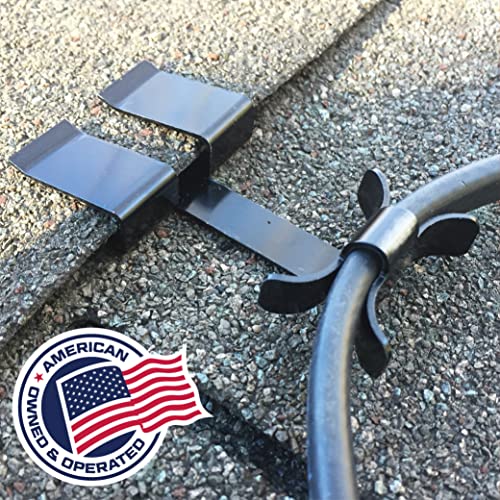
The common layout is a row of triangles along the edge: the cable climbs from the gutter to a point above the exterior wall line, comes back down, and repeats, carrying heat past the cold overhang. Clips hold each peak and valley without nails, which would pierce the jacket and the shingle. One pass runs along the gutter, then down each downspout past the point where its outlet freezes. Triangle height and spacing depend on the product, so the installation sheet in the box beats any diagram online, this one included.
How much cable: roof edge, gutters and downspouts
- Roof edge. Measure only the eaves where ice forms. For a 12 in. overhang, plan on roughly 2.5 to 3 ft of cable per foot of edge; for a 24 in. overhang, closer to 4.
- Gutter. One pass: 1 ft of cable per foot of gutter.
- Downspouts. The full height, down and back up if the downspout ends in the air.
Example: a bungalow with a 24 ft front, a 12 in. overhang, 24 ft of gutter and one 9 ft downspout. Edge 24 × 2.75 = 66 ft, gutter 24 ft, downspout 9 ft: about 99 ft, which is the 100 ft kit. Two slopes or two downspouts quickly reach 160 or 200 ft. A fixed cable that comes out long gets a tighter zig-zag, never a cut.
Pipe heat tape: insulation, plastic pipe and the fasteners
The cable runs straight along the pipe, or in a loose spiral on a large one, held with the tape the manufacturer specifies. Three rules. It goes against the pipe, never around the outside of existing insulation. Insulation goes over it only if the manufacturer allows it, and then the type they name. And it goes on plastic pipe only if the product is rated for plastic; all three pipe products here state it.
The eight products, compared on published specs
Every figure below is the manufacturer’s own, from the Amazon.ca listing. Where a listing gives no number, the table says so.
| Product | Use | Length | Type | Thermostat |
|---|---|---|---|---|
| HEATIT HIRD 100 ft roof and gutter de-icing cable | Roof edge, gutter, downspout | 100 ft, fixed | Constant wattage | None built in |
| HEATIT HIRD 200 ft roof and gutter de-icing cable, 5 W/ft | Two slopes, long eave | 200 ft, fixed | Constant wattage, 5 W/ft | None built in |
| HEATIT 8PLSR 30 ft self-regulating heat cable, 8 W/ft | Pipes, short roof or gutter runs | 30 ft | Self-regulating, 8 W/ft | None stated |
| HEATIT JHSF 24 ft pipe heat cable with thermostat | Water supply pipe | 24 ft | Self-regulating, 3 W/ft | Built in: on at 38 °F (3 °C), off at 50 °F (10 °C) |
| Frost King HC24A automatic pipe heat cable, 24 ft | Water supply pipe | 24 ft | 7 W/ft (type not stated) | "Automatic" per title, temperatures not given |
| Grip Clip nail-free roof clips, model 325, 25 pack | Holding roof cable on shingles | 25 clips | Accessory | Not applicable |
| HEATIT ET-24 thermostatically controlled outlet | Any cable without a thermostat | Plug-in | Accessory | On below 38 °F (3 °C), off around 50 °F (10 °C) |
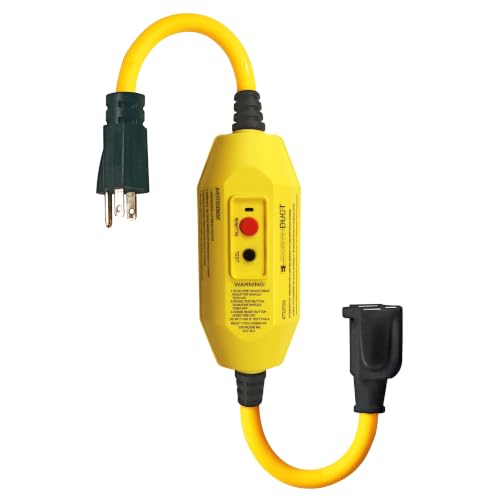
| Electriduct inline GFCI cord, 15 A, auto reset | Outlet without GFCI protection | 18 in. cord | Accessory | Not applicable |
Which one for your house
HEATIT HIRD 100 ft roof and gutter de-icing cableConstant wattage · 100 ft, fixedThe one-façade kit: our sizing example below lands at about 99 ft. The listing states ETL and CSA certification, a 6 ft cold lead with plug, and clips and spacers in the box.Watch out: This listing does not state watts per foot; its 160 and 200 ft siblings state 5 W/ft. It cannot be cut and must not touch, cross or overlap itself. Rated for metal or plastic gutters and noncombustible shingles such as asphalt.Check price ↗HEATIT HIRD 200 ft roof and gutter de-icing cable, 5 W/ftConstant wattage, 5 W/ft · 200 ft, fixedTwo exposed slopes, or one long eave with two downspouts. Same construction as the 100 ft: ETL and CSA, 6 ft cold lead, clips and spacers included.Watch out: 1,000 W, about 8.3 A at 120 V: most of what a 15 A circuit should carry continuously, so nothing heavy should share it. Never join two fixed cables end to end.Check price ↗HEATIT 8PLSR 30 ft self-regulating heat cable, 8 W/ftSelf-regulating, 8 W/ft · 30 ftA valley, a short gutter or an exposed water line where the cable has to double back. The listing states ETL and UL certification, plastic and metal pipes, and no burnout risk from overlapping.Watch out: No cold lead length and no thermostat on the listing. It still draws power whenever plugged in, so pair it with a plug-in thermostat such as the ET-24.Check price ↗HEATIT JHSF 24 ft pipe heat cable with thermostatSelf-regulating, 3 W/ft · 24 ftAn entry line in a crawl space, a mobile home supply line or a cottage pipe. The listing names copper, PVC and stainless steel, states ETL certification and says it keeps water flowing down to −40 °F (−40 °C). Straight, spiral or overlapped runs are allowed.Watch out: The power cord is only 2 ft long, so the outlet has to be close to the start of the pipe. At 3 W/ft this is a pipe product, not a roof cable.Check price ↗Frost King HC24A automatic pipe heat cable, 24 ft7 W/ft (type not stated) · 24 ftThe classic hardware-store format. The listing states 120 V, 7 W/ft, use on metal and plastic water pipes, and water kept flowing down to −40 °F.Watch out: The listing does not say whether it is constant wattage or self-regulating, when it switches, or whether insulation may cover it. Until the instructions in the box say otherwise, treat it as constant wattage: no overlap.Check price ↗Grip Clip nail-free roof clips, model 325, 25 packAccessory · 25 clipsExtra clips when the kit runs short. The listing says they push onto the roofing with no nails, screws or tools, go on in cold weather and fit any brand of de-icing cable on most asphalt shingle roofs.Watch out: Model 325 is for roofing 1/8 in. to 3/8 in. thick; 625 and 875 are for thicker material. A clip at every peak and valley uses 25 quickly.Check price ↗HEATIT ET-24 thermostatically controlled outletAccessory · Plug-inThe accessory that saves the most power on a fixed roof cable. The listing states CSA certification, a 15 A maximum, an indicator light, and use with roof de-icing cables and pipe heating cables.Watch out: The listing says dry locations only, so it belongs under an in-use outlet cover, never loose in the snow. Its warranty paragraph also refers to an "ET-21", an editing slip on the listing. It reads the air where it sits, so a sunny wall will keep it off longer.Check price ↗Electriduct inline GFCI cord, 15 A, auto resetAccessory · 18 in. cordA stopgap when the only outdoor outlet has no TEST and RESET buttons. The listing states Class A GFCI, 15 A, automatic reset after a power loss, 12/3 SJTW cord, and UL and cUL rainproof rating for outdoor use.Watch out: A stopgap, not the fix. The proper answer is a GFCI receptacle with an in-use cover, installed by an electrician. If it trips again and again, inspect the cable and the connections before resetting it one more time.Check price ↗



Mobile homes, cottages, RVs and what American guides leave out
- Mobile homes. The supply line under the skirting is the classic heat tape job. Use a product rated for your pipe material and keep the skirting closed against the wind.
- Cottages. Heat tape only works while the power is on. Ice storms knock out power for days in exactly the weather you bought it for, so a cottage left empty all winter is still safer drained than heated.
- RVs. The inlet and fresh-water hose freeze first. Short self-regulating cable on a GFCI-protected outlet is the usual answer.
- Install in October. Shingles are dry and flexible and ladders do not slip. In January the shingles are brittle and the edge is already iced. Unplug from spring to fall.
Where to buy in Canada
| Retailer | Strength | Note |
|---|---|---|
| Amazon.ca | Every HEATIT length, self-regulating cable, thermostats, clips | Check watts per foot and certification on each listing |
| Canadian Tire | Roof and pipe cable kits in season | Shelves thin out after the first snowfall |
| Home Depot | Cable, clips, foam pipe insulation and GFCI receptacles together | Handy for the accessories |
| RONA | Roof kits and pipe tapes | Selection varies by store |
| Home Hardware | Pipe heat tape in rural stores | Good for a cottage or farm run |
Frequently asked questions
Is heat tape the same thing as heat trace cable?
Same family, different words. "Heat tape" is the everyday name, "heat trace" the trade term for cable that runs along a pipe to keep it above freezing. Roof and gutter de-icing cable is a separate product. Check what the listing is rated for, not what it is called.
Can I use pipe heat tape on my roof?
Only if the listing rates it for roofs. The HEATIT 8PLSR is sold for both pipes and roofs. The HEATIT JHSF and the Frost King HC24A are sold for water pipes only, and at 3 to 7 W/ft they are not designed to cut a channel through roof ice.
Does a heat cable stop ice dams?
It treats the symptom by keeping a drain channel open through the edge ice. The cause is heat escaping into the attic and warming the roof deck; air sealing, insulation and ventilation fix that.
Can I put insulation over heat tape?
Usually yes with self-regulating cable, and foam pipe insulation over the cable is what keeps the heat on the pipe. But some products forbid it or require a specific insulation type, and the Frost King listing does not say either way. Read the instructions in the box before you wrap anything.
Does a heat cable need a GFCI outlet?
Yes. Heating cable that lives outdoors, in water and ice, needs ground-fault protection, and an outdoor outlet should already be GFCI protected under an in-use cover. If yours has no TEST and RESET buttons, have it replaced before winter.
How much electricity does heat tape use?
Watts times hours. A 1,000 W roof cable running 12 hours a day for 120 days uses 1,440 kWh. Left on around the clock from October to April without a thermostat, the same cable can use several times that. Multiply by your provincial rate for a dollar figure.
Keep reading
Keeping the steps and the driveway clear instead of the roof? Our guide to heated snow melting mats in Canada covers the same GFCI and load rules. Working on a cold garage? See the best garage heaters in Canada. For the driveway itself, read our guide to the best electric and battery snow blowers in Canada, and when the thaw arrives, our guide to the best basement dehumidifiers in Canada.