
Best Electric Garage Heater in Canada (2026)
Specs checked November 3, 2026 · Version française
The best garage heater is decided before you look at a single product page. The outlet you have sets the ceiling: a standard 120 V plug tops out at 1,500 W, and anything that can actually heat a garage needs a dedicated 240 V circuit. What you want the heat for sets the size: keeping a garage above freezing and keeping it warm enough to work in are two very different loads. Get those two right and the choice of model is the easy part.
The short answer
- Heat the whole garage all winter: a 240 V hardwired fan-forced ceiling heater with a thermostat, installed by an electrician.
- Insulated single garage, or a double kept frost-free: about 5,000 W.
- Insulated double garage you work in: 7,500 W and up, and check your panel first.
- No wiring, occasional use: a 1,500 W infrared heater aimed at where you stand. It warms you, not the room.
How we picked, and what we did not do: we have not bench-tested these heaters. Every specification on this page is quoted from the manufacturer’s own Amazon.ca listing, checked November 3, 2026, and every item was confirmed in stock in Canada that day. Where a listing contradicts itself or another listing, we say so. Links to Amazon are affiliate links; BranchéQC may earn a commission at no extra cost to you. We do not publish prices by hand; the Amazon page is what counts. We do not link to any unvented propane heater for indoor use.
120 V plug-in or 240 V hardwired: what each can actually heat
A 120 V plug-in heater is capped at 1,500 W because that is about what a standard 15 A household circuit is built to carry. At 120 V, 1,500 W draws roughly 12.5 A, which is most of that circuit, so nothing else should run on it at the same time. These heaters need no installation and no permit. They are also the reason so many people decide garage heaters “do not work”: 1,500 W spread across a cold double garage with a thin door barely registers on the thermometer.
A 240 V hardwired heater is a different class of appliance. The listings on this page run from 5,000 W to 8,500 W, between three and almost six times the output of the best plug-in. At 240 V, 5,000 W draws about 20.8 A, 7,500 W about 31 A and 8,500 W about 35 A. None of them come with a cord; each listing says it must be hardwired on its own circuit by a qualified electrician. In return you get a heater that can bring a garage up to temperature and hold it there.
The honest rule: if you want to plug something in tonight, stay at 120 V and use it as a spot heater. If you want a heated garage, budget for a 240 V unit plus the circuit.
How to size a garage heater
There is no reliable chart, because the same floor area can need twice the heat depending on the building. A common rule of thumb for an insulated space with an ordinary ceiling height is about 10 watts per square foot to keep it warm. On that rough basis, an insulated single garage needs a few thousand watts and an insulated double needs 5,000 W or more. Treat that as a starting point, then adjust for four things.
- Insulation. An insulated, drywalled garage holds heat. Bare studs and an uninsulated slab do not, and no rule of thumb survives them. In that case, insulate first or spot heat the work area with infrared.
- The door. The overhead door is usually the biggest single loss. Every time it opens, the warm air leaves, and a heater sized only on floor area takes a long time to recover. If the door opens often, size up.
- Target temperature. Holding a garage a few degrees above freezing takes far less heat than holding it at shirt-sleeve working temperature. Decide which one you want before you buy.
- Ceiling height. A tall ceiling means more air to heat, and warm air pools up there. Louvres that point the airflow down toward the floor matter more in a tall garage.
One more caution: coverage figures on listings are not comparable between brands. On the day we checked, a 7,500 W unit claimed up to 1,250 sq ft while an 8,500 W unit claimed 850. The wattage is the number that obeys physics; size from that.
Ceiling fan-forced, infrared or portable
A ceiling-mounted fan-forced heater pushes air across a heating element and blows it into the space. Mounted high in a corner and angled down, it stays clear of car doors, ladders and the hood of the car. It is the standard way to heat a whole garage, and it is what every 240 V pick on this page is.
An infrared heater warms whatever it faces, the way sunlight does, instead of heating the air. That makes it the best 120 V option for a garage: you feel the heat within seconds even when the air is cold, and opening the door does not erase it. The trade-off is that it heats only what it can see. Step out of its path and you are back in a cold garage.
A portable ceramic heater is the small fan-forced box most people already own. It is fine at a desk in a heated room and limited in a garage, where it is a foot warmer at best. Whichever type you choose, keep the clearances in the manual and keep it well away from fuel cans, solvents, paint and sawdust.
Thermostat: the part that sets your bill
A garage heater without a thermostat runs flat out or not at all, and in a Canadian winter that means it runs flat out. A thermostat lets it cycle just enough to hold the temperature you set, which is how a 5,000 W heater can keep a garage frost-free for a modest share of its rated power.
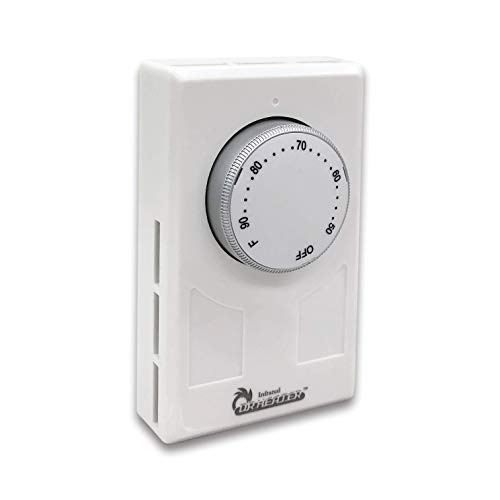
Most 240 V units now include a built-in thermostat. The catch is that it sits in the heater, up on the ceiling, measuring the warmest air in the room. A line-voltage wall thermostat wired ahead of the heater puts the control at shoulder height by the house door and reads the temperature where you actually are. Two things to check: that the thermostat is rated for the heater’s full wattage at 240 V, and that the heater’s manual allows one. A thermostat for a 240 V baseboard is not the same thing as the 24 V thermostat on a furnace; the wrong type will not work and can be dangerous.
The circuit: breaker, wire and permit
A 240 V garage heater needs a dedicated circuit on a double-pole breaker. Because a heater runs for hours at a time, it is treated as a continuous load and the circuit is sized with headroom above its draw. The breaker size and the wire gauge come from the heater’s installation manual and your electrical code, not from a forum thread, and they change with wattage: a 7,500 W unit needs a heavier circuit than a 5,000 W one. Every listing on this page says the same thing in its own words: hire a qualified electrician.
Then there is the panel. An attached garage is usually fed from the main panel, which needs two free spaces and enough spare capacity. A detached garage is often fed by a subpanel, which is also a sensible place to add a heater circuit if it has room. An older 100 A service that already carries a range, a dryer and electric water heating may not have the capacity for a 7,500 W heater, and an electrician will do a load calculation before adding one. If you are also thinking about an EV charger in that garage, plan both circuits at the same time; it is often cheaper than running them in two separate visits.
A new 240 V circuit usually needs a permit and an inspection, and the rules on what a homeowner may do vary by province. In Quebec, this work must be done by a licensed electrical contractor. If you live in Quebec, you can request a free quote from a licensed master electrician for the heater circuit (Quebec only).
The seven picks, compared on published specs
Every figure below is the manufacturer’s own, from the Amazon.ca listing. Where a listing gives no number, the table says so instead of guessing.
| Model | Mount | Voltage | Wattage | Thermostat | Stated coverage |
|---|---|---|---|---|---|
| Lasko 754201 ceramic heater, 1,500 W | Portable, fan-forced ceramic | 120 V plug-in | 1,500 W high, 900 W low | Manual dial | Rooms up to 100 sq ft |
| Dr. Infrared carbon infrared heater with tripod | Tripod or wall mount, infrared | 120 V plug-in | 900, 1,200 or 1,500 W | None listed (three power levels) | Not stated |
| TEMPWARE 5,000 W ceiling garage heater | Ceiling, fan-forced | 240 V hardwired | 3,000, 4,000 or 5,000 W (17,060 BTU) | Built-in mechanical dial | Up to 592 sq ft |
| TEMPWARE 7,500 W ceiling garage heater | Ceiling, fan-forced | 240 V hardwired | 6,250 to 7,500 W (25,590 BTU) | Built-in, 45 to 95 °F | Up to 1,250 sq ft |
| CTSC 8,500 W ceiling or wall garage heater | Ceiling or wall, fan-forced | 240 V hardwired | 8,500 W high, 4,250 W low | Built-in sensor, pre-wired for an external thermostat | Up to 850 sq ft |
| Dr. Infrared DR-001 line-voltage wall thermostat | Wall box, double pole | 120 to 277 V | Up to 6,720 W at 240 V (28 A) | Mechanical dial, 5 to 32 °C | Not applicable |
| First Alert CO605A plug-in carbon monoxide alarm | Plug-in, 9 V battery backup | 120 V outlet | Not applicable | Not applicable | Electrochemical CO sensor |
Which one for your garage
Lasko 754201 ceramic heater, 1,500 W120 V plug-in · Portable, fan-forced ceramicA workbench corner where you sit or stand close to the heat. Lasko says it plugs into a standard 120 V outlet and lists a tip-over switch and automatic overheat protection.Watch out: Lasko itself rates it for rooms up to 100 sq ft. In a garage this warms your legs at the bench, not the space.Check price ↗Dr. Infrared carbon infrared heater with tripod120 V plug-in · Tripod or wall mount, infraredWorking in a cold or poorly insulated garage where the door opens often. Infrared warms you and the bench directly instead of the air. The listing gives it an IP55 rating for indoor and outdoor use.Watch out: No thermostat is listed, so it cannot hold the garage at a set temperature. For outdoor use the listing requires a GFCI outlet.Check price ↗TEMPWARE 5,000 W ceiling garage heater240 V hardwired · Ceiling, fan-forcedThe typical insulated single garage, or a double garage you only need to keep above freezing. Three power steps let it idle low for most of the winter.Watch out: No power cord. The listing states it is a 240 V hardwired unit that requires installation by a qualified electrician.Check price ↗TEMPWARE 7,500 W ceiling garage heater240 V hardwired · Ceiling, fan-forcedAn insulated double garage or a workshop you want warm enough to work in, not just frost-free. The listing adds an ECO mode and a 1 to 12 hour timer.Watch out: The 1,250 sq ft claim is generous next to the 8,500 W unit below, which claims 850. Size from wattage, not from coverage claims. It also needs a bigger circuit than a 5,000 W unit.Check price ↗CTSC 8,500 W ceiling or wall garage heater240 V hardwired · Ceiling or wall, fan-forcedA large or poorly insulated double garage where you want the control on the wall by the house door. It is the only heater here whose listing says it is pre-wired for an external thermostat.Watch out: The title says ETL listed and a bullet says CSA certified, so check the certification mark on the unit itself. 8,500 W is a large draw for a home panel; confirm capacity before you order.Check price ↗Dr. Infrared DR-001 line-voltage wall thermostat120 to 277 V · Wall box, double polePutting control of a hardwired heater on the wall instead of on the ceiling. The listing notes double terminals that give a positive off position.Watch out: 6,720 W at 240 V covers the 5,000 W TEMPWARE but not the 7,500 or 8,500 W units. Check that the heater's manual allows a line-voltage thermostat ahead of it, and have the electrician wire it.Check price ↗First Alert CO605A plug-in carbon monoxide alarm120 V outlet · Plug-in, 9 V battery backupAny house with an attached garage, and not optional if anyone ever runs a propane heater, an idling car or a generator out there. One button tests and mutes.Watch out: It is a household alarm. Put it in the house on the garage side, where its manual directs; the listing gives no operating temperature for an unheated garage.Check price ↗



Gas, propane and diesel garage heaters: the honest comparison
Combustion heaters put out a lot of heat and need no 240 V circuit, which is why they show up in every garage heater search. They are not interchangeable with electric, and they are not interchangeable with each other. The question that separates them is where the exhaust goes.
| Type | Exhaust | Installation | Main risk |
|---|---|---|---|
| Electric, 120 V or 240 V | None | 120 V: none. 240 V: electrician | Overloaded circuit, clearances |
| Natural gas unit heater | Vented outdoors | Licensed gas fitter, gas line, vent | Installation quality |
| Propane unit heater, vented | Vented outdoors | Licensed gas fitter, vent | Installation quality |
| Portable propane heater | Into the garage | None | Carbon monoxide, open flame |
| Diesel air heater | Exhaust pipe outdoors | Varies widely, often DIY | Exhaust leaks, fuel storage |
A vented natural gas or propane unit heater, installed by a licensed gas fitter, sends its combustion gases outside and is a legitimate way to heat a large garage where gas is already on site. A portable propane heater is not vented: everything it burns ends up in the air you breathe. Many are labelled for ventilated spaces and some include a low-oxygen shut-off, but that is not permission to run one with the door closed, and never in a garage attached to the house. A diesel air heater burns fuel in a sealed chamber and pipes the exhaust out, which is safe only as long as that pipe and its seals stay intact.
Whatever you burn, a working carbon monoxide alarm on the house side of the garage door is not optional. Carbon monoxide has no smell and no colour. That is why the last pick above is a CO alarm and why no combustion heater appears in our picks.
What the American reviews leave out
- The heater runs for months, not days. A garage in most of Canada needs heat from November to March or longer. That makes the thermostat, not the peak wattage, the feature that decides what the heater costs to own.
- Electricity is cheap in some provinces. In Quebec and a few other provinces, low electricity rates tip the running cost toward electric. American round-ups are usually written for markets where gas wins.
- Frost-free is often the real goal. Many Canadians do not want a warm garage; they want one that does not freeze the washer fluid and the paint. That is a smaller heater on a low thermostat setting, not the biggest unit on the shelf.
- The garage already has other loads. Block heaters, a freezer, power tools and increasingly an EV charger all compete for the same panel. Plan the heater circuit with all of them in view.
Where to buy in Canada
| Retailer | Strength | Note |
|---|---|---|
| Amazon.ca | Widest range of 240 V ceiling units and line-voltage thermostats | Read the voltage line and the mounting note before ordering |
| Home Depot | Mainstream garage heaters and thermostats in store | Easy to see the unit size before buying |
| Canadian Tire | Seasonal range, frequent promotions | Stock peaks in fall and thins out by January |
| Costco | Seasonal shop heaters at good value | Limited selection; check whether it is 120 V or 240 V |
| RONA | Electrical aisle for breakers, wire and boxes | Your electrician may supply these anyway |
| Princess Auto | Shop and workshop heaters | Many are commercial units; check the voltage and mounting |
Frequently asked questions
What is the best garage heater for a Canadian winter?
For a garage you want heated all winter, a 240 V hardwired fan-forced ceiling heater with a thermostat. Around 5,000 W suits an insulated single garage or a double kept just above freezing; 7,500 W and up suits an insulated double you want to work in. For occasional use without any wiring, a 1,500 W infrared heater on a stand warms you directly even when the garage itself stays cold.
Can a 1,500 W plug-in heater heat a garage?
It can keep a person warm at a bench, and it can take the edge off a small, well insulated single garage. It cannot bring a typical Canadian garage to a comfortable temperature in January. 1,500 W is the practical ceiling for a standard 120 V outlet, which is why every serious garage heater is 240 V.
How many watts do I need to heat a garage?
A common rule of thumb for an insulated space with an ordinary ceiling is about 10 watts per square foot to keep it warm. Treat it as a starting point. A big uninsulated door, high ceilings or a door that opens every hour push the number up; keeping the space just above freezing brings it down. 1,000 W equals 3,412 BTU per hour if you need to compare with a gas heater.
Can I plug a garage heater into my dryer or welder outlet?
Only if the heater is sold with a plug that matches that outlet and its manual allows it, and only if the circuit is rated for the heater's draw. The 240 V heaters on this page are hardwired units with no cord at all. Fitting a plug to a hardwired heater yourself is the wrong fix; have an electrician run a proper circuit.
Do I need a permit to install a 240 V garage heater?
A new 240 V circuit is regulated electrical work in every province, and it usually needs a permit and an inspection. In Quebec it must be done by a licensed electrical contractor. Elsewhere, the rules on what a homeowner may wire vary by province, so check with your provincial electrical safety authority before you start.
Is it safe to leave an electric garage heater on overnight?
A hardwired ceiling heater on a thermostat is designed to cycle on and off unattended; that is its job. A portable heater is a different case: follow its manual, keep clearances, never run it on an extension cord or power bar, and keep it away from fuel cans, solvents and sawdust.
Is electric or propane cheaper to heat a garage?
It depends entirely on your local electricity rate and the price of propane, which is why we do not publish a single number. To compare, convert both to the same unit: 1 kWh of electric heat is about 3,412 BTU, and an electric heater turns all of it into heat in the garage. In provinces with low electricity rates, such as Quebec, electric usually comes out ahead.
What temperature should I keep my garage at in winter?
If the goal is protecting stored paint, liquids and any water line, a few degrees above freezing is enough, and that is where a thermostat earns its price. Working comfortably takes a lot more heat and a lot more energy. Decide which of the two you want before you size the heater.
Keep reading
Getting the car ready for winter as well? Our block heater guide for Canada is the next stop. Heating a room in the house rather than the garage? See our guide to the best space heaters in Canada. If a water line in the garage keeps freezing, our guide to heat tape for roofs and pipes covers the fix. And for the driveway outside, our guide to the best electric and battery snow blowers in Canada applies the same rule as this page: read the specification line before the headline number.