
Top choices
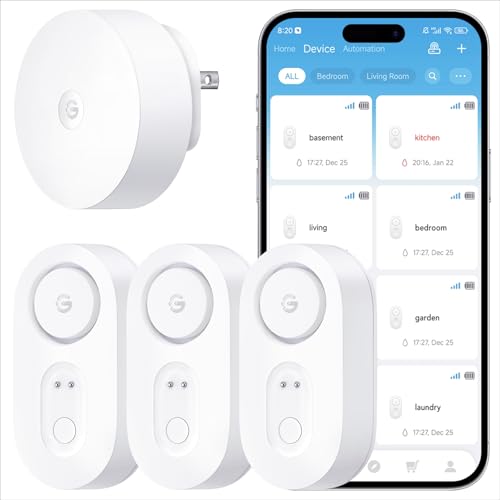
Specs as stated on the manufacturers' listings; the price shows on the retailer's page. No app · just a loud beepGeevon water leak alarm, 4-packYou are home most of the time and want a loud beep under the kitchen sink, behind the washer and by the water heater. Three metal prongs underneath, 3.15 in across, 1.18 in tall, and the listing says it floats if the floor goes under.Watch out: Nothing reaches your phone. If a pipe lets go while you are at work or at the cottage, you find out when you get back. No battery life figure on the listing.Check price on Amazon.ca ↗
 One awkward spot · no hubSwitchBot Wi-Fi water leak detector with 1 m cableOne spot that is hard to reach: behind a water heater, under a fridge, in a sump pit. The 1 m sensing cable goes where the puck cannot, the four probes trip at 0.5 mm of water per the listing, and it joins your 2.4 GHz Wi-Fi with no gateway to buy. Works with Alexa, Google, Siri, IFTTT and SmartThings.Watch out: One sensor per Wi-Fi connection: five of them is five setups. AAA cells, so plan the swap, and the app warns when they run low.Check price on Amazon.ca ↗
 You already run a hub · ZigbeeTHIRDREALITY Zigbee water leak sensor, 4-packYou already run Home Assistant, SmartThings, an Aeotec hub or the Third Reality hub. The siren is in the sensor itself and the listing says it still sounds when the internet is off. Over-the-air updates per the listing.Watch out: No hub, no notification: these are not Wi-Fi sensors. Apple Home and Google Home need the brand's MZ1 bridge, sold separately.Check price on Amazon.ca ↗
Water, not fire, is the claim most Canadian homeowners actually make. A washing machine hose splits on a Tuesday afternoon; a 15-year-old water heater lets go on the first cold night; the sump pump trips during the spring melt. A water leak detector is a small puck with metal probes underneath. Water bridges the probes, the puck screams, and depending on what you bought, your phone buzzes or the main valve closes. The whole category costs less than one deductible, and the difference between the three tiers is what happens when nobody is home.
The short answer
- Most houses: the GoveeLife 1s 3-pack with gateway. App, SMS and email, 105 dB on each puck, 5-year battery as listed.
- No app, just a loud beep: the Geevon 9 V alarms, four to a box.
- One awkward spot, no hub: the SwitchBot with its 1 m probe cable, straight onto your 2.4 GHz Wi-Fi.
- You already run a hub: the THIRDREALITY Zigbee 4-pack, 120 dB siren in the sensor.
- Cottage or cold basement: the Moen Flo detector, which the listing says also reads temperature and humidity.
- Water off automatically: Flo by Moen on the main line, installed by a plumber, or the Sinopé Sedna, a Quebec-made valve with battery backup.
- Sump pit: the Sekelo float alarm, 110 dB, plus a battery puck on the floor beside it.
How we picked, and what we did not do: we have not poured water on these sensors ourselves. Every specification on this page is quoted from the manufacturer’s Amazon.ca listing, checked November 6, 2026, and every product on a card or in a link was in stock in Canada that day. Where a listing leaves a number out, battery life for example, we say so instead of guessing. Temperature and freeze features are mentioned only where the listing states them. Links to Amazon are affiliate links; BranchéQC may earn a commission at no extra cost to you. We do not write prices by hand: the button says “Check price” and the Amazon page is what counts.
Where leaks happen in Canadian homes
Put the sensors where the water will be, not where it is convenient. In order of how often we hear about them:
- The water heater. Tanks rust from the inside and fail at the bottom seam, usually in the first cold weeks when the incoming water is at its coldest and the tank works hardest. One puck in the drip pan or on the floor at the base. If the tank sits in a closet with no drain, this is your most valuable sensor.
- The washing machine. Rubber supply hoses age; a split one delivers the full pressure of your main until someone closes the taps. A puck on the floor behind the machine, where the puck cannot reach, is the job for a probe cable.
- Under sinks and the dishwasher. Slow drips from a trap or a dishwasher supply line rot the cabinet floor for months before anyone notices. One puck per cabinet.
- The sump pit. A float switch sticks, a breaker trips, the discharge line freezes outside in February and the pit fills. A high-water alarm hangs in the pit; a floor puck beside it catches the overflow.
- Cottage pipes in winter. A pipe along an outside wall freezes, splits, and thaws in March while you are in the city. Here the sensor you want reads temperature as well as water, and it reaches your phone, because nobody is there to hear a siren.
- Toilets and the water main. A cracked tank or a failed supply valve. A puck behind each toilet and one near the main shut-off.
How to choose a water leak sensor
Five questions settle it, and the first one matters most.
- How do you want to be told? A siren only works if someone is home. A phone alert works anywhere with signal. An automatic valve works even if you are on a plane. Each tier costs more than the last, and the first two can be mixed: a loud sensor and a notification.
- How many spots? Count them from the list above. A house with a basement laundry, two bathrooms, a kitchen and a water heater is six to eight. Multipacks with a gateway get cheaper per sensor; single no-hub sensors get expensive and tedious past three or four.
- What is your Wi-Fi? Every Wi-Fi sensor and gateway on this page states 2.4 GHz only. If your router combines 2.4 and 5 GHz under one name, some devices will refuse to pair until you split the bands or stand next to the router. Zigbee and the long-range radios used by GoveeLife and YoLink do not use Wi-Fi between sensor and hub at all, which is why they reach a detached garage.
- What powers it, and for how long? Read the battery type and the stated life. A built-in cell that lasts five years means the sensor is disposable at the end; AAA cells mean you change them. A 9 V alarm with no stated life means a yearly test with a wet finger.
- Can it reach the spot? A puck is a puck. Behind a water heater or in a sump pit you want a probe cable, which the SwitchBot includes at 1 m and which Moen and GoveeLife sell as accessories for their own systems.
Standalone alarm, smart sensor or automatic shut-off
The standalone alarm is a 9 V or AAA puck with a siren. The Geevon states 100 dB; the THIRDREALITY and X-Sense listings state 120 dB. No app, no account, no router. It is the right answer for a bungalow where someone is always home, and the wrong one for a cottage.
The smart water leak detector adds a radio. Three families exist on Amazon.ca. Wi-Fi sensors with no hub, such as the SwitchBot, each join your router on their own. Gateway systems, such as GoveeLife, put a long-range radio in the puck and one plug-in gateway on your Wi-Fi; the listing claims 550 m through five walls, which is the pitch for a basement-to-garage layout. Zigbee sensors, such as THIRDREALITY and Aqara, need a Zigbee hub you may already own. All three tiers send app notifications; GoveeLife adds free SMS per its listing, and some brands sell phone-call alerts as a paid option. The Daytech Wi-Fi sump and leak sensor, for instance, lists app alerts as included and phone or SMS alerts as an optional paid service. Read that line before you count on a text.
The automatic shut-off valve is the only tier that stops the water. Flo by Moen replaces a section of your main line and monitors flow, pressure, moisture and temperature. The Sinopé Sedna, made in Quebec, is a 3/4 in NPT stainless steel valve that closes when any of up to 20 Sinopé detectors trips, with no hub needed on the Neviweb app per the listing. Clip-on controllers that turn your existing lever, such as the operator in the YoLink water shut-off kit, avoid pipe cutting but still need a lever-style ball valve in good condition.
Subscription or local: who stores the alert
None of the sensors on this page requires a monthly plan to send a basic push notification, as of the listings we read. The differences sit in the extras. GoveeLife says SMS is free however many you use. YoLink says each account gets five free SMS per month plus five per device. Daytech sells calls and texts as an option. Moen’s Flo app shows daily consumption and sets conservation goals per the listing, with no plan mentioned for the basic alerts. If a brand you are considering mentions a “premium” tier, find out what the free tier still does the day you stop paying: usually the siren and the app push stay, and the phone call goes.
The Zigbee route is the most local. The THIRDREALITY listing is explicit that the sensor’s siren works when the internet is off, and under Home Assistant the automation that turns off a smart plug on the washer runs on your own hardware. That is also the route with the most setup.
What happens during a power or internet outage
This is the question Canadian winters ask every year, and the listings answer it unevenly. Work through the chain: sensor, hub or gateway, router, internet, valve.
- Battery sensors keep beeping. Every puck above runs on a battery, so the local siren survives an outage. That is the whole argument for a loud siren even on a smart sensor.
- Plug-in gateways and your router go dark. The GoveeLife gateway, the X-Sense base station, the Zigbee hub and the router all plug into the wall. No power, no notification, unless you put the router and the hub on a small UPS, which is the cheapest fix on this page.
- Wi-Fi survives but the internet does not: local sirens and local automations still run; cloud notifications wait until the connection returns.
- Valves need their own answer. Flo by Moen’s listing requires a standard AC/DC power connection and mentions no backup. The Sinopé Sedna states emergency operation on four AAA lithium batteries, not included. The YoLink kit states device-to-device pairing so the valve closes on a sensor trip even with no power, no Wi-Fi and no internet, and the valve controller runs two years on batteries or on power with battery backup, per the listing.
- Sump pumps stop with the power. That is when the pit fills. A plug-in sump alarm stops too. If the basement matters, the pump needs a battery backup pump and the alarm needs a battery.
For a cottage you leave for weeks, the honest setup is a battery siren at every spot, one notification path, and a shut-off valve with battery backup. Our portable power station guide covers keeping a router and a sump pump alive through a multi-day outage.
Freeze alerts and temperature sensing for cottages and basements
A leak puck reacts to water on its probes. Frozen water is not on the probes; it is inside the pipe, and the puck finds out in March. Only a sensor that also measures temperature can warn you in January, and on Amazon.ca that feature is rarer than the titles suggest. Among our picks, two listings state it. The Moen Flo detector 920-004 says it monitors the room’s temperature and humidity to help protect against frost and mould risk, and sends real-time app notifications. The Flo by Moen shut-off says it monitors temperature along with flow, pressure and moisture. The GoveeLife, SwitchBot, THIRDREALITY and Geevon listings state no temperature feature, so do not expect one.
For the pipe itself, pairing a temperature alert with a heat cable on the vulnerable run and a smart thermostat that reports the room temperature gives you two independent warnings before the water does any damage. A smart plug on the heat cable lets you switch it from the city.
Battery life, as the listings state it
The figures below are the manufacturers’ own, with the battery type where the listing gives it. “Not stated” means exactly that.
| Model | Battery | Stated life | Low-battery warning |
|---|---|---|---|
| GoveeLife 1s (3-pack) | Built-in, type not stated | 5 years | App |
| Geevon 9 V alarm | 6F22 9 V, included | Not stated | Not stated |
| SwitchBot Wi-Fi | 2 × AAA, included | Up to 2 years | App notification |
| THIRDREALITY Zigbee | 2 × AAA, included | 3 years | App battery level |
| Moen Flo detector | Not stated | Not stated | Not stated |
| Sinopé Sedna valve | 4 × AAA lithium backup, not included | Not stated | Not stated |
| YoLink kit sensors | Not stated | Up to 5 years | Not stated |
Lithium cells deliver less current as the temperature falls, and a sensor in an unheated pump room or a garage will not see the stated life. Alkaline AAA cells fade faster still below freezing. Put sensors in the coldest spots on a yearly battery routine, and test every puck with a wet fingertip when the clocks change.
Automatic shut-off valves: what you are buying
A whole-home valve is the only device here that reduces the damage instead of reporting it. Three designs are in stock in Canada.
- Inline monitor and valve. Flo by Moen is cut into the main. Its daily MicroLeak test pressurizes the house and looks for a drop the listing says can be as small as a drop per minute, which catches pinhole leaks behind walls that no floor puck will ever see. Three sizes exist: 3/4 in (900-001), 1 in (900-006) and 1-1/4 in (900-002); the listing says to consult a professional on the size.
- Inline valve driven by sensors. The Sinopé Sedna closes when a paired Sinopé detector trips. The listing lists conformity with CSA B125.3-12 plumbing fittings and NSF/ANSI 61, a stainless steel body, a self-test routine, Alexa, Google Home and SmartThings. The detectors are sold separately.
- Clip-on operator. The YoLink EVO and similar controllers bolt over your existing lever valve and turn it. No pipe cutting, per the listing, but the existing valve has to turn freely, and a 30-year-old gate valve with a round handle does not qualify.
One habit matters more than the brand: close and reopen your main shut-off by hand twice a year. A valve that has not moved in a decade may not move when the controller asks it to.
Insurance: ask before you buy
Many Canadian home insurers offer a discount for leak detection devices, and a larger one for an automatic shut-off valve on the main line. The amounts vary by insurer, by province and by device, some insurers list specific approved models, and a few run their own sensor programs. We do not print percentages here because the one your insurer quotes is the only one that counts. Call them first, ask which devices and which installation qualify, ask whether a plumber’s invoice is required, and keep the receipt. A discount that pays back a Wi-Fi multipack in a year or two is common; a discount that pays for a whole-home valve takes longer and depends entirely on your premium.
There is a second reason to call. Several insurers now ask, at renewal, whether the house has leak detection or a shut-off valve, and the answer can affect more than the discount. A sensor you paid for and installed is a sensor you can say yes to.
Privacy in Canada
A leak sensor sends very little: a device identifier, a wet-or-dry state, a battery level and, for some, a temperature reading, to the manufacturer’s servers, usually outside Canada. The app accounts hold your email, your phone number for SMS, and the name you gave each room. Federal privacy law and the provincial laws that apply in Quebec, Alberta and British Columbia give you a right to know what a company holds about you and to ask that it be deleted; the practical steps are to read the app’s privacy policy before you create the account, use an email you control, share the device only with people who need the alerts, and delete the account when you sell the house or the cottage. A Zigbee sensor under a local hub such as Home Assistant keeps the data in the house, which is the simplest answer for anyone who finds the question uncomfortable.
DIY, plumber or electrician
Sensors are DIY in every province. Pull the battery tab, pair the app, put the puck on the floor with the probes down. A probe cable runs behind the appliance with tape. A plug-in gateway goes on any outlet. Nothing here touches your wiring or your plumbing.
An inline valve is plumber work. Flo by Moen and the Sinopé Sedna replace a section of your main line; that is a cut, two joints and a pressure test, and in most provinces a permit. Moen’s own listing says to consult a professional on the size, and your insurer may require the plumber’s invoice to grant the discount. A clip-on operator can be DIY if your existing valve is a lever ball valve.
A new outlet near the valve is electrician work. Flo by Moen requires a standard AC/DC power connection. If the main comes in where there is no outlet, which describes most Canadian basements, anything hardwired, a new receptacle included, is a licensed electrician in every province. An extension cord along the floor beside the water main is the one thing not to do. If you also want the water heater or the washer on a monitored circuit, a smart plug handles the 120 V appliance; the 240 V water heater does not plug in and is not a smart-plug job.
The seven picks, compared on published specs
Every figure is the manufacturer’s own. Where a listing gives no number, the table says so.
| Model | Type | How it tells you | Power | Battery life (as listed) |
|---|---|---|---|---|
| GoveeLife Smart Water Leak Detector 1s, 3-pack with gateway | Wi-Fi multipack (gateway) | App, SMS, email; 105 dB on the sensor | Gateway plugs in; sensors on built-in battery | 5 years, as listed |
| Geevon water leak alarm, 4-pack | Standalone alarm, no app | 100 dB siren only | 9 V battery (included) | Not stated |
| SwitchBot Wi-Fi water leak detector with 1 m cable | Wi-Fi, no hub, probe cable | App and email; 100 dB on the sensor | 2 × AAA (included) | Up to 2 years, as listed |
| THIRDREALITY Zigbee water leak sensor, 4-pack | Zigbee, hub required | App and free email through the hub; 120 dB on the sensor | 2 × AAA (included) | 3 years, as listed |
| Moen Flo Smart Water Leak Detector 920-004 | Wi-Fi sensor with temperature | App; audible alarm | Battery, type not stated on the listing | Not stated |
| Flo by Moen Smart Water Shutoff 900-001, 3/4 in | Automatic shut-off valve | App; closes the main automatically | Standard AC/DC power connection (required) | Not applicable |
| Sekelo sump pump high water alarm, 110 dB | Sump pit float alarm | 110 dB siren and LED | Plug-in, 6 ft cord | Not applicable |
Which water leak detector for your house
GoveeLife Smart Water Leak Detector 1s, 3-pack with gatewayWi-Fi multipack (gateway) · Gateway plugs in; sensors on built-in batteryThe default for a house or a cottage: three sensors, a gateway that reaches 550 m (1,804 ft) through five walls per the listing, free SMS, four alarm volumes and an IP67 shell. The GoveeLife app can add several email addresses, so a neighbour or a relative also gets the alert.Watch out: The gateway is 2.4 GHz only and pairs only with GoveeLife H5059 sensors, says the listing. If the gateway loses power or Wi-Fi, the sensor still beeps but your phone stays silent.Check price ↗Geevon water leak alarm, 4-packStandalone alarm, no app · 9 V battery (included)You are home most of the time and want a loud beep under the kitchen sink, behind the washer and by the water heater. Three metal prongs underneath, 3.15 in across, 1.18 in tall, and the listing says it floats if the floor goes under.Watch out: Nothing reaches your phone. If a pipe lets go while you are at work or at the cottage, you find out when you get back. No battery life figure on the listing.Check price ↗SwitchBot Wi-Fi water leak detector with 1 m cableWi-Fi, no hub, probe cable · 2 × AAA (included)One spot that is hard to reach: behind a water heater, under a fridge, in a sump pit. The 1 m sensing cable goes where the puck cannot, the four probes trip at 0.5 mm of water per the listing, and it joins your 2.4 GHz Wi-Fi with no gateway to buy. Works with Alexa, Google, Siri, IFTTT and SmartThings.Watch out: One sensor per Wi-Fi connection: five of them is five setups. AAA cells, so plan the swap, and the app warns when they run low.Check price ↗THIRDREALITY Zigbee water leak sensor, 4-packZigbee, hub required · 2 × AAA (included)You already run Home Assistant, SmartThings, an Aeotec hub or the Third Reality hub. The siren is in the sensor itself and the listing says it still sounds when the internet is off. Over-the-air updates per the listing.Watch out: No hub, no notification: these are not Wi-Fi sensors. Apple Home and Google Home need the brand's MZ1 bridge, sold separately.Check price ↗Moen Flo Smart Water Leak Detector 920-004Wi-Fi sensor with temperature · Battery, type not stated on the listingThe cottage, the unheated basement, the garage with a hose bib. The listing says it monitors the room's temperature and humidity to help protect against frost and mould risk, on top of water on the floor. It can also tell a Flo shut-off valve to close.Watch out: The listing gives neither the battery type nor a life figure. Single pack; the 3-pack is a separate listing. Premium brand pricing: check the button.Check price ↗Flo by Moen Smart Water Shutoff 900-001, 3/4 inAutomatic shut-off valve · Standard AC/DC power connection (required)You want the water off before you even read the alert. Installed on the main line, it monitors flow, pressure, moisture and temperature, runs a daily MicroLeak test the listing says catches a drop per minute, and shuts the house down on a burst. Fits 3/4 in to 1-1/4 in pipe per the listing, which itself says to consult a professional.Watch out: Cutting into the main line is plumber work in Canada, and the valve needs a powered outlet nearby. No battery backup is mentioned on the listing: read the outage section below.Check price ↗Sekelo sump pump high water alarm, 110 dBSump pit float alarm · Plug-in, 6 ft cordA float switch on a 10 ft cable hangs in the pit and screams when the water climbs past where the pump should have kicked in: failed pump, tripped breaker, frozen discharge line. IP67 enclosure rated for indoor and outdoor use, per the listing.Watch out: Plug-in only. In a power outage, the pump stops and so does this alarm, which is exactly when the pit fills. Pair it with a battery sensor on the floor beside the pit.Check price ↗


Damp basement or actual leak?
A puck that trips every humid week in July is usually reading condensation on a cold concrete floor, not a leak. The RUIKORING and similar listings warn that heavy mist can trigger the top probes. Move the puck onto a small tile or a piece of plastic so it sits proud of the slab, and deal with the humidity itself: our basement dehumidifier guide for Canada covers sizing for a Canadian below-grade room. A sensor that trips once a day is a sensor you will unplug, and an unplugged sensor protects nothing.
Water is one of the two alerts worth getting on your phone when the house is empty. The other is smoke and carbon monoxide: see our guide to the best smart smoke and CO detector in Canada, which uses the same hub-or-Wi-Fi logic as the leak sensors above.
Frequently asked questions
What is the best water leak sensor for a Canadian home?
For most houses, a Wi-Fi multipack with a gateway, such as the GoveeLife 1s 3-pack: app, SMS and email alerts, a 105 dB siren on each sensor and a 5-year battery life as listed. If you only want a loud beep and no app, the Geevon 9 V alarms. If you want the water shut off automatically, add a valve such as Flo by Moen.
How do I choose a water leak sensor?
Decide how you want to be told (siren only, phone, or automatic shut-off), count the spots to cover, check that your router has a 2.4 GHz network, read the battery type and life on the listing, and look for a probe cable if the spot is behind an appliance. Then look at what still works when the power or the internet drops.
Does the Govee water sensor need a hub?
Yes. The GoveeLife 1s sensors talk to a plug-in gateway on a long-range radio, and the gateway joins your 2.4 GHz Wi-Fi. The listing says the gateway pairs only with GoveeLife H5059 sensors. The SwitchBot sensor is the no-hub alternative in our picks.
Do water leak detectors work during a power outage?
Battery sensors keep beeping. Anything that depends on a plug-in gateway, your router or a plug-in valve stops notifying or stops moving when the power is out, unless the listing states a battery backup or offline pairing, as the Sinopé Sedna valve and the YoLink kit do.
Can a water leak sensor detect freezing pipes at the cottage?
Only a sensor that measures temperature. Among our picks, the Moen Flo detector 920-004 states that it monitors the room's temperature and humidity to help protect against frost risk, and the Flo shut-off valve monitors water temperature. A plain leak puck only reacts to water on its probes.
Do I need a plumber to install a smart water shut-off valve?
For a valve that is cut into the main line, such as Flo by Moen or the Sinopé Sedna, yes: a licensed plumber, and an electrician if a new outlet is needed nearby. Clip-on valve controllers that turn your existing lever, such as the YoLink EVO, are sold as no-pipe-cutting installs. Placing floor sensors is DIY in every province.
Will a water leak detector lower my home insurance in Canada?
Often, but the discount depends on the insurer, the province and the device, and the biggest discounts usually require an automatic shut-off valve rather than sensors alone. Call your insurer before you buy, ask which devices qualify, and keep the receipt and the installation invoice.
Where should I place water leak sensors?
Under the water heater, behind the washing machine, under the kitchen sink and the dishwasher, under each bathroom sink and toilet, beside the sump pit, and near the water main. At the cottage, add the pump room and any pipe run along an outside wall.
Keep reading
The rest of the connected-home shelf, checked the same way: the best smart plugs in Canada for switching a heat cable or a dehumidifier from your phone, and the best smart thermostats in Canada for a second temperature reading at the cottage.
If the basement is damp rather than flooded, start with the best basement dehumidifiers in Canada. If outages are the worry, the best portable power stations in Canada explains what will run a sump pump and a router, and for how long.