

Top choices
Specs as stated on the manufacturers' listings; the price shows on the retailer's page. Router and phones · carry anywhereBluetti Elite 30 V2Router, modem, phones and a laptop through an evening outage, or a car fridge on a road trip. 4.3 kg (9.4 lb), a 10 ms UPS for the router and 80 % charge in 45 minutes, as listed.Watch out: 288 Wh will not carry a household fridge for long. The 1,500 W Power Lifting mode is for a small kettle or toaster, says the listing. No cycle count stated.Check price on Amazon.ca ↗
 CPAP night · weekend campingBluetti AC70A CPAP night, a weekend at a campsite, or the router and lights with reserve to spare. One cable charges it at up to 850 W, and the listing gives 1.9 to 2.4 hours on 500 W of solar.Watch out: A 20 ms UPS, slower than the 10 ms on the Elite listings. No cycle count and no weight on the listing. CPAP draw varies by machine: check its manual.Check price on Amazon.ca ↗
 Short outage · fridge for an eveningBluetti Elite 100 V2A fridge, the router and lights through a short outage, in an 11.3 kg (25 lb) box with a hidden handle. 10 ms UPS, 30 dB silent mode, 11 ports and a stated cycle count.Watch out: The title says 3,600 W surge and the bullets say 2,700 W Power Lifting: two different numbers, so plan on 1,800 W. One kilowatt-hour is an evening, not an ice storm.Check price on Amazon.ca ↗
Bluetti is one of the best-known names in lithium power stations sold in Canada: a maker founded in 2009 that builds on lithium iron phosphate (LiFePO4, or LFP) batteries. A Bluetti charges from the wall, the sun or the car, makes no exhaust and needs no oil. This page is the map of the Bluetti range as sold on Amazon.ca in November 2026: which model for which outage or trip, what each listing states and leaves out, and how the brand lines up against EcoFlow and Jackery on listed capacity, output and chemistry. How to size a station of any brand is a separate question, answered in our guide to the best portable power station in Canada.
The short answer
- Router, modem and phones for an evening: the Elite 30 V2, 288 Wh and 600 W in a 4.3 kg (9.4 lb) box, as listed.
- A CPAP night or a camping weekend: the AC70, 768 Wh and 1,000 W.
- A fridge through a short outage: the Elite 100 V2, 1,024 Wh and 1,800 W, the in-stock answer to an AC180 search.
- A fridge, router and lights for most of a day: the Elite 200 V2, 2,073.6 Wh and 2,600 W. If it should stay in the kitchen for good, the wall-mounted FridgePower.
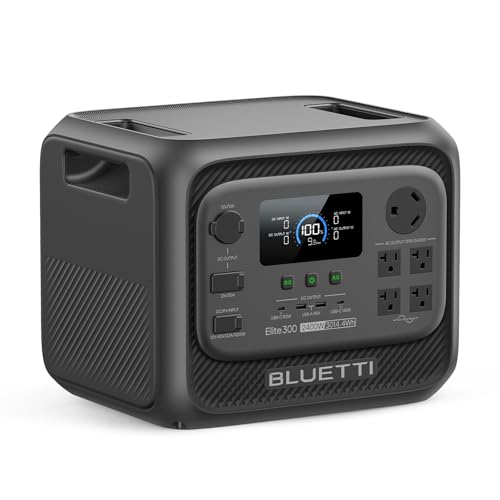
- A long outage or an RV: the Elite 300, 3,014.4 Wh with a TT-30 outlet.
- A house with 240 V loads: the Apex 300, 3,840 W at 120 V and 240 V, expandable, with an electrician for anything wired to the panel.
How we picked, and what we did not do: we have not bench-tested any Bluetti. Every specification on this page is quoted from the manufacturer’s Amazon.ca listing, checked November 10, 2026, and every product linked was in stock in Canada that day. Where a listing leaves a number out or gives two different ones, we say so. Links to Amazon are affiliate links; BranchéQC may earn a commission at no extra cost to you. We do not write prices by hand: the button says “Check price on Amazon.ca” and the Amazon page is what counts.
The Bluetti range on Amazon.ca in 2026
Two naming families share the shelf. The AC series (AC70, AC180, AC200L) is the line our French guide was built around, and the Elite series (Elite 30 V2, 100 V2, 200 V2, 300, 400) is what fills Amazon.ca today, with the capacity class in the name: an Elite 100 is about 1 kWh, an Elite 200 about 2 kWh. On November 10, 2026, the stations in stock that we read line by line were the Elite 30 V2, AC70, Elite 100 V2, FridgePower, Elite 200 V2, Apex 300 and Elite 300. Also in stock, and named here without a card: the pocket-sized Elite 10 Mini (128 Wh, 200 W, 1.8 kg or 4.0 lb), the older EB3A (268 Wh, 600 W, LiFePO4) and the wheeled Elite 400 (3,840 Wh, 2,600 W). The AC2A (204 Wh, 300 W) showed a shipping delay that day, so it is not a pick.
What did not come up matters as much: no Bluetti-brand AC180 and no AC200L, the two AC models Canadians still search for by name. Each gets its own section below. Our French guide also covers the AC500 and EP900 whole-home systems from bluettipower.ca; we did not check those on Amazon.ca for this page.
Which Bluetti power station for which outage or trip
Start from energy, not from the model name. These are the orders of magnitude our French guide uses for a household; the nameplate on your own appliance overrides them.
| What you keep running | Typical draw | Energy over 24 h |
|---|---|---|
| Recent fridge-freezer | 100 to 150 W running, 600 to 1,200 W to start | 1 to 2 kWh |
| Sump pump | 800 to 1,000 W per cycle | 0.5 to 2 kWh, depending on cycles |
| Router, modem, phone charging | 15 to 30 W | 0.4 to 0.7 kWh |
| LED lighting, 5 bulbs for 6 h | 50 W | 0.3 kWh |
| CPAP without heated humidifier, 8 h | 30 to 60 W | 0.25 to 0.5 kWh |
| 1,500 W baseboard or space heater | 1,500 W | Empties an Elite 200 V2 in about 1 h 20 |
Fridge, router, lights and a CPAP together come to 2 to 3.5 kWh per 24 hours. That is why a 2 kWh station covers a night and part of the next day, and why a sump pump that cycles often pushes you to the Elite 300, the Apex 300 or an expanded FridgePower. Electric heat is out of reach of any of them: our space heater guide is for heat on mains power, and our heated blanket guide for warmth on far fewer watts.
| Outage or trip | Reserve to look for | Bluetti in stock |
|---|---|---|
| Router and phones, one evening | About 300 Wh | Elite 30 V2 |
| CPAP night, weekend camping, car fridge | About 750 Wh | AC70 |
| Fridge through a short outage | About 1 kWh | Elite 100 V2 |
| Fridge overnight, installed for good | About 2 kWh | FridgePower |
| Fridge, router, lights for most of a day | About 2 kWh | Elite 200 V2 |
| Long outage, RV, sump pump | About 3 kWh | Elite 300 |
| House with 240 V loads, room to expand | 2.8 kWh and up | Apex 300 |
Bluetti AC70: 768 Wh for a CPAP night or a weekend away
The Bluetti AC70 is the one AC-series station that came up in stock in our lookup, and its listing is short and clear: 768 Wh, a 1,000 W inverter with 2,000 W in Power Lifting mode, LFP chemistry, and a 20 ms UPS. It charges through a single cable with no power brick, at up to 850 W: 0 to 80 % in 45 minutes and full in 1.5 hours. Solar input goes up to 500 W, for a full charge in 1.9 to 2.4 hours as listed. The box holds the wall cable, a car charging cable and a solar cable. What the listing does not give: a cycle count, a weight, or any temperature range. Below it, the Elite 30 V2 is the grab-and-go size: 288 Wh, 600 W, 10 ms UPS, and standby draw the listing puts at 4.5 W.
Bluetti AC180: what Amazon.ca stocks in its place
The AC180 is the second most-searched Bluetti model in our Canadian keyword data, and on November 10, 2026 our Amazon.ca lookup returned no Bluetti-brand listing for it: only third-party charging cords and adapters made for the AC180, while Bluetti’s own 200 W solar panel listing still names it as compatible. Our French guide, working from bluettipower.ca, lists the AC180 at 1,152 Wh; if you want that exact model, the brand’s Canadian store is where to look.
The 1 kWh Bluetti you can order on Amazon.ca is the Elite 100 V2: 1,024 Wh, 1,800 W of rated AC output, 11 ports, a 10 ms UPS for the router and a desktop, 30 dB in silent mode, and 11.3 kg (25 lb). It refills in about 70 minutes on 1,200 W from the wall or on up to 1,000 W of solar, and the listing gives over 4,000 cycles to 80 % capacity. One thing to read twice: the title says 3,600 W surge and the bullets say 2,700 W Power Lifting. Size your appliances on the 1,800 W both agree on.
Bluetti Elite 200 V2 and the AC200L question
The Bluetti Elite 200 V2 is the most-searched Bluetti model in our Canadian keyword data, and the one our French guide calls the brand’s flagship. Its listing states 2,073.6 Wh, 2,600 W continuous and 3,900 W in Power Lifting mode across four AC outlets, with up to nine devices at once. Standby draw is given as 10 W. Charging comes in three modes chosen in the app: Turbo at 1,800 W for 0 to 80 % in one hour, Standard at up to 1,440 W for a full charge in 1.6 hours, and Silent at 800 W for a full charge in 3 hours at 16 to 30 dB. With 1,000 W of solar panels the listing gives 2.4 hours. The battery is described as automotive-grade LiFePO4 with over 6,000 cycles and a 17-year lifespan: the maker’s figures, on the maker’s protocol. The listing gives no UPS switchover time and no weight.
As for the AC200L: no Bluetti-brand listing for it came up in our lookup either. Our French guide lists it at 2,048 Wh, the same class as the Elite 200 V2, so on Amazon.ca the newer model is simply the one on offer. We compare the Elite 200 V2 with 2 kWh units from other brands in the portable power station guide.
FridgePower, Apex 300 and Elite 300: Bluetti for home backup
Three listings are written for the house. The FridgePower is the unusual one: a 2,016 Wh, 1,800 W station only 75 mm (3 in) thick, meant to sit behind the fridge or hang on the wall with the brackets in the box. Its UPS switches to battery in 10 ms, standby draw is listed at 4 W, the app pushes severe-weather alerts and starts charging ahead of a storm, and it expands to 8,064 Wh with BlueCell 200 batteries. The four days of fridge runtime in the listing refer to that expanded setup.
The Elite 300 packs 3,014.4 Wh and 2,400 W (4,800 W surge) into what the listing calls the smallest 3 kWh station, with a 10 ms UPS, a TT-30 RV outlet, a 12 V, 30 A DC output and a full charge in as little as 78 minutes. The Apex 300 is the step toward a home system: 2,764.8 Wh, 3,840 W with a 7,680 W surge, 120 V and 240 V at the same time, six AC outlets, 2,400 W of solar input built in, and expansion by paralleling two or three units or adding B300K batteries, up to 58 kWh as listed. Plugging appliances straight into any of them needs no installation. Feeding circuits of the house is different: that takes a transfer switch installed by a licensed electrician, in every province.
Bluetti solar panels: 200 W and 60 W
The Bluetti 200 W folding panel is the one whose title names the EB3A, AC2A, AC70, AC180, AC200L and Elite 200 V2 among compatible stations. Its listing gives monocrystalline cells at up to 23.4 % efficiency, an ETFE coating against scratches and splashes, adjustable kickstands, a folded size of about 57 × 60 × 7 cm (22.5 × 23.6 × 2.9 in) and 7.8 kg (17.2 lb). No waterproof rating is stated, and the Elite 100 V2, Elite 30 V2 and Elite 300 are not in its title: check the connector before you pair them. The small 60 W panel is the match for the Elite 30 V2 and Elite 10, per its title: IP65, 1.4 kg, and two efficiency figures on the same listing (23.4 % in the title, 24.7 % in the bullets).
Keep winter in mind. Our French guide is blunt about it: a folding panel produces little in December, with short days, a low sun and snow, so for an outage longer than 24 hours plan on recharging from the car or a small generator rather than from the panel.
Bluetti vs EcoFlow, on what the listings state
The two brands chase the same buyer with the same recipe: LiFePO4 cells, fast wall charging, an app, and a range that runs from a camping box to a modular home system. Here they are class for class, using only the capacity, continuous output and chemistry printed on each brand’s own Amazon.ca listing on November 10, 2026.
| Class | Bluetti, as listed | EcoFlow, as listed |
|---|---|---|
| About 300 Wh | Elite 30 V2: 288 Wh, 600 W, LFP | RIVER 3 Plus: 286 Wh, 600 W, LFP |
| About 1 kWh | Elite 100 V2: 1,024 Wh, 1,800 W, LiFePO4 | DELTA 3 Classic: 1,024 Wh, 1,800 W, LiFePO4 |
| About 2 kWh | Elite 200 V2: 2,073.6 Wh, 2,600 W, LiFePO4 | DELTA 3 Max: 2,048 Wh, 2,400 W, LiFePO4 |
| About 3 kWh | Elite 300: 3,014.4 Wh, 2,400 W, LiFePO4 | DELTA 3 Ultra: 3,072 Wh, 3,600 W, LiFePO4 |
At 300 Wh and 1 kWh the listed numbers are the same. At 2 kWh Bluetti lists more continuous output; at 3 kWh EcoFlow does. Both brands also advertise a boost mode for heating appliances (Power Lifting at Bluetti, X-Boost at EcoFlow), which is not the same thing as continuous output. Our French guide adds two observations beyond the listings: Bluetti leans on modular systems you expand over time, while EcoFlow tends to charge a little faster from the wall on its Delta models and has a wider accessory range in Canada. Neither is the better brand overall; the right one is the better listing in your capacity class the week you buy. For the 1 kWh EcoFlow in detail, with runtime estimates per appliance and the Classic, Plus, 1500 and Max decision, read our EcoFlow Delta 3 review.
Bluetti vs Jackery, on what the listings state
| Class | Bluetti, as listed | Jackery, as listed |
|---|---|---|
| About 1 kWh | Elite 100 V2: 1,024 Wh, 1,800 W, LiFePO4 | Explorer 1000 v2: 1,024 Wh, 1,500 W, LiFePO4 |
| About 2 kWh | Elite 200 V2: 2,073.6 Wh, 2,600 W, LiFePO4 | Explorer 2000 v2: 2,042 Wh, 2,200 W, LiFePO4 |
| About 3 kWh | Elite 300: 3,014.4 Wh, 2,400 W, LiFePO4 | HomePower 3000: 3,072 Wh, 3,600 W, LFP |
Capacity is close in every class and the chemistry is the same on these current listings. Output is where they part: Bluetti lists more watts at 1 kWh and 2 kWh, Jackery lists more at 3 kWh. Where a UPS time is given, the Elite 100 V2 and Elite 300 state 10 ms, the Explorer 2000 v2 states 20 ms and the HomePower 3000 states 20 ms or less; the Elite 200 V2 listing gives none. On cycle life, compare like with like: the Elite 100 V2 claims over 4,000 cycles to 80 % capacity, the HomePower 3000 claims 4,000 cycles to 70 %.
The bigger difference is where you buy. Jackery sits on store shelves across Canada, which brings its own trap: older generations on a different battery chemistry are still being cleared. Our guide on where to buy Jackery in Canada covers the retailers, the check to do on the box and the warranty on the official store. Bluetti, by our French guide’s account, sells mostly online. If seeing the unit before paying matters to you, that weighs toward Jackery; if listed output per class matters more, read the two tables above against your appliances.
LiFePO4 in a Canadian winter: what Bluetti listings say
Not much, in numbers. None of the seven listings on this page states an operating or charging temperature. The Elite 200 V2 listing promises “safe use even in extreme temps” and the Elite 30 V2 listing mentions “extreme outdoor climates”, neither with a figure; the EB3A listing only says charging speed depends on ambient temperature.
So we fall back on the rule in our French guide. LiFePO4 handles cold better than conventional lithium-ion, but most models refuse to recharge below 0 °C (32 °F), a protection built into the battery management system, and recharging performance declines below freezing. Keep the station indoors: a basement, a heated garage, an insulated shed, not an unheated one in January. Bring it out to work, then bring it back in to charge. And look up the charge and discharge temperatures in the manual of the exact model before you rely on it at a winter cottage.
The seven Bluetti picks, compared on published specs
Every figure is the manufacturer’s own, from the Amazon.ca listing. Where a listing gives no number, the table says so.
| Model | Capacity | AC output | Battery | UPS | Recharge, as listed |
|---|---|---|---|---|---|
| Bluetti Elite 30 V2 | 288 Wh | 600 W (1,500 W Power Lifting) | LFP; cycle count not stated in the listing | 10 ms | 380 W wall: 0 to 80 % in 45 min, full in 70 min |
| Bluetti AC70 | 768 Wh | 1,000 W (2,000 W Power Lifting) | LFP; cycle count not stated in the listing | 20 ms | 850 W wall: 0 to 80 % in 45 min, full in 1.5 h; solar up to 500 W |
| Bluetti Elite 100 V2 | 1,024 Wh | 1,800 W (surge: see Watch out) | LiFePO4; over 4,000 cycles to 80 %, as listed | 10 ms | 1,200 W wall or up to 1,000 W solar: full in about 70 min |
| Bluetti FridgePower | 2,016 Wh | 1,800 W (3,600 W surge) | LFP; cycle count not stated in the listing | 10 ms | Not stated in the listing |
| Bluetti Elite 200 V2 | 2,073.6 Wh | 2,600 W (3,900 W Power Lifting) | LiFePO4; over 6,000 cycles, 17 years claimed | Not stated in the listing | 1,800 W wall: 0 to 80 % in 1 h; 1,000 W solar: full in 2.4 h |
| Bluetti Apex 300 | 2,764.8 Wh | 3,840 W (7,680 W surge), 120 V and 240 V at once | LFP; cycle count not stated in the listing | Not stated in the listing | Wall: 80 % in 45 min; solar 2,400 W built in |
| Bluetti Elite 300 | 3,014.4 Wh | 2,400 W (4,800 W surge) | LiFePO4; cycle count not stated in the listing | 10 ms | 0 to 100 % in as fast as 78 min |
The Bluetti picks, one card each
Bluetti Elite 30 V2288 Wh · 600 W (1,500 W Power Lifting)Router, modem, phones and a laptop through an evening outage, or a car fridge on a road trip. 4.3 kg (9.4 lb), a 10 ms UPS for the router and 80 % charge in 45 minutes, as listed.Watch out: 288 Wh will not carry a household fridge for long. The 1,500 W Power Lifting mode is for a small kettle or toaster, says the listing. No cycle count stated.Check price on Amazon.ca ↗Bluetti AC70768 Wh · 1,000 W (2,000 W Power Lifting)A CPAP night, a weekend at a campsite, or the router and lights with reserve to spare. One cable charges it at up to 850 W, and the listing gives 1.9 to 2.4 hours on 500 W of solar.Watch out: A 20 ms UPS, slower than the 10 ms on the Elite listings. No cycle count and no weight on the listing. CPAP draw varies by machine: check its manual.Check price on Amazon.ca ↗Bluetti Elite 100 V21,024 Wh · 1,800 W (surge: see Watch out)A fridge, the router and lights through a short outage, in an 11.3 kg (25 lb) box with a hidden handle. 10 ms UPS, 30 dB silent mode, 11 ports and a stated cycle count.Watch out: The title says 3,600 W surge and the bullets say 2,700 W Power Lifting: two different numbers, so plan on 1,800 W. One kilowatt-hour is an evening, not an ice storm.Check price on Amazon.ca ↗Bluetti FridgePower2,016 Wh · 1,800 W (3,600 W surge)Built to live behind or beside the fridge: 75 mm (3 in) thin, on its feet or on the wall, a 10 ms switch to battery and 4 W of standby draw. The listing names sump pumps and chest freezers too.Watch out: A fixed installation, not a station you carry to the lake. The four-day fridge claim needs BlueCell 200 expansion batteries, up to 8,064 Wh. No cycle count or charge time stated.Check price on Amazon.ca ↗Bluetti Elite 200 V22,073.6 Wh · 2,600 W (3,900 W Power Lifting)About 2 kWh for a fridge, the router and lights through a night and part of the next day, 2,600 W for a coffee maker or hair dryer, and 10 W of standby draw, as listed.Watch out: The 6,000 cycles and 17 years are the maker's figures, on its own protocol. No UPS switchover time and no weight on this listing.Check price on Amazon.ca ↗Bluetti Apex 3002,764.8 Wh · 3,840 W (7,680 W surge), 120 V and 240 V at onceThe Bluetti for a house rather than a trip: 120 V and 240 V at the same time, six AC outlets, 3,840 W, and room to grow by paralleling units or adding B300K batteries, up to 58 kWh as listed.Watch out: No cycle count, UPS time or weight on this listing. Feeding a home panel from it takes a transfer switch installed by a licensed electrician.Check price on Amazon.ca ↗Bluetti Elite 3003,014.4 Wh · 2,400 W (4,800 W surge)The largest reserve of the seven: fridge, router, lights, TV and a CPAP through an outage, per the listing, plus a TT-30 RV outlet and a 12 V, 30 A DC output for a camper van.Watch out: 2,400 W continuous, less than the Elite 200 V2's 2,600 W: you buy more hours, not more power. No cycle count or weight stated.Check price on Amazon.ca ↗

Where to buy Bluetti in Canada
| Where | What you find | Note |
|---|---|---|
| bluettipower.ca | The brand's Canadian store: full range, frequent promotions | Manufacturer's warranty handled directly, per our French guide |
| Amazon.ca | Seven stations and two folding panels in stock on November 10, 2026 | Prefer a listing sold by Bluetti, for the warranty |
| Specialty backup-power and outdoor retailers | A limited selection of models | Stock varies from one store to the next |
Those three channels are the ones our French guide documents, and we name no big-box chain because nothing we checked for this page confirms one. Three habits are worth keeping. Compare the same model on bluettipower.ca and Amazon.ca the day you buy, in cost per watt-hour rather than against a struck-through price. Look for a 30-day return window and confirm the warranty length with the seller, since none of the seven listings states one. And expect after-sales service to be slower than at a local shop: the brand operates mostly online. With Black Friday on November 27, 2026, our French guide notes that November pricing has tended to appear in the first days of the month on both sites.
BranchéQC’s verdict on Bluetti
Bluetti is an easy brand to buy in Canada if you buy online: seven stations in stock on Amazon.ca, all LFP or LiFePO4, with a clean ladder from 288 Wh to 3 kWh and a 240 V option above it. The Elite 200 V2 is the centre of the range and the listing backs its place with real figures. The price of the brand is what the listings leave blank: no operating temperature on any of the seven, a cycle count on only two, no warranty length, and two surge figures on the Elite 100 V2. The AC180 and AC200L that people still search for have given way to the Elite line on Amazon.ca. Against EcoFlow and Jackery there is no overall winner, only a better listing in each class.
Bluetti in Canada: frequently asked questions
Is Bluetti sold in Canada?
Yes. On November 10, 2026, Amazon.ca had seven Bluetti stations in stock that we checked one by one: Elite 30 V2, AC70, Elite 100 V2, FridgePower, Elite 200 V2, Apex 300 and Elite 300, plus the 200 W and 60 W folding solar panels. Bluetti also sells directly on bluettipower.ca, its Canadian store, which our French guide describes as carrying the full range with the manufacturer's warranty handled directly.
Which Bluetti power station should I buy?
Size it on watt-hours for the outage or trip you actually have. Router and phones for an evening: Elite 30 V2, 288 Wh. A CPAP night or a weekend of camping: AC70, 768 Wh. A fridge through a short outage: Elite 100 V2, 1,024 Wh. A fridge, router and lights for most of a day: Elite 200 V2, 2,073.6 Wh. A long outage or an RV: Elite 300, 3,014.4 Wh. A house with 240 V loads: Apex 300.
Is the Bluetti AC180 available on Amazon.ca?
Not when we looked. On November 10, 2026, our Amazon.ca lookup returned no Bluetti-brand AC180 station, only third-party charging cords made for it, although Bluetti's 200 W solar panel listing still names the AC180 as compatible. The 1 kWh Bluetti in stock that day was the Elite 100 V2: 1,024 Wh, 1,800 W, LiFePO4, over 4,000 cycles to 80 % as listed. For the AC180 itself, check bluettipower.ca.
Bluetti AC200L or Elite 200 V2?
On Amazon.ca on November 10, 2026, the choice was made for you: no Bluetti-brand AC200L station came up, and the Elite 200 V2 was in stock. Its listing states 2,073.6 Wh, 2,600 W continuous, 3,900 W in Power Lifting mode, 10 W of standby draw and over 6,000 cycles. Our French guide, working from bluettipower.ca, lists the AC200L at 2,048 Wh; look there if you want that model.
Bluetti vs EcoFlow: which is better?
Neither wins overall. Class for class the listings are close: Elite 100 V2 and DELTA 3 Classic both state 1,024 Wh, 1,800 W and LiFePO4; at about 2 kWh the Elite 200 V2 lists 2,600 W against 2,400 W for the DELTA 3 Max; at about 3 kWh the DELTA 3 Ultra lists 3,600 W against 2,400 W for the Elite 300. Pick the capacity first, then compare the two listings in that class the week you buy.
Bluetti vs Jackery: what is the difference?
On current Amazon.ca listings both use LiFePO4. Bluetti lists more continuous output at 1 kWh (1,800 W against 1,500 W for the Explorer 1000 v2) and at 2 kWh (2,600 W against 2,200 W for the Explorer 2000 v2); Jackery lists more at 3 kWh (3,600 W for the HomePower 3000 against 2,400 W for the Elite 300). Jackery is also on store shelves in Canada, which our where-to-buy page covers.
Can a Bluetti run a fridge through a power outage?
Yes, and the question is for how long. Our French guide puts a recent fridge-freezer at 1 to 2 kWh per 24 hours. An Elite 100 V2 (1,024 Wh) is roughly half a day to a day for the fridge alone, before conversion losses; an Elite 200 V2 or a FridgePower (about 2 kWh) covers roughly a day for the fridge, router and lights. The nameplate on your own appliance is what counts.
Is a Bluetti safe to use indoors?
Yes. A battery power station produces no exhaust and no carbon monoxide, so it can run in a basement, a living room or a bedroom during an outage. A gas generator must always run outside.
Does a Bluetti work in a Canadian winter?
Indoors, yes. None of the seven listings we read states an operating or charging temperature. Our French guide's rule: LiFePO4 handles cold better than conventional lithium-ion, but most models refuse to recharge below 0 °C to protect the battery, so keep the station in the basement or a heated garage, never in an unheated shed. Check the manual for your model's limits.
Where is the Bluetti warranty best in Canada?
Our French guide points to bluettipower.ca for the manufacturer's warranty handled directly, and to listings marked as sold by Bluetti on Amazon.ca. None of the seven Amazon.ca listings we read states a warranty length, so confirm it on the listing or with the seller before you pay. The same guide notes that after-sales service can be slower than with a local retailer, because the brand sells mostly online.
Keep reading beyond Bluetti
To size a station of any brand on watt-hours, the best portable power station in Canada. For the EcoFlow in the 1 kWh class, the EcoFlow Delta 3 review. For Jackery in stores and online, where to buy Jackery in Canada.